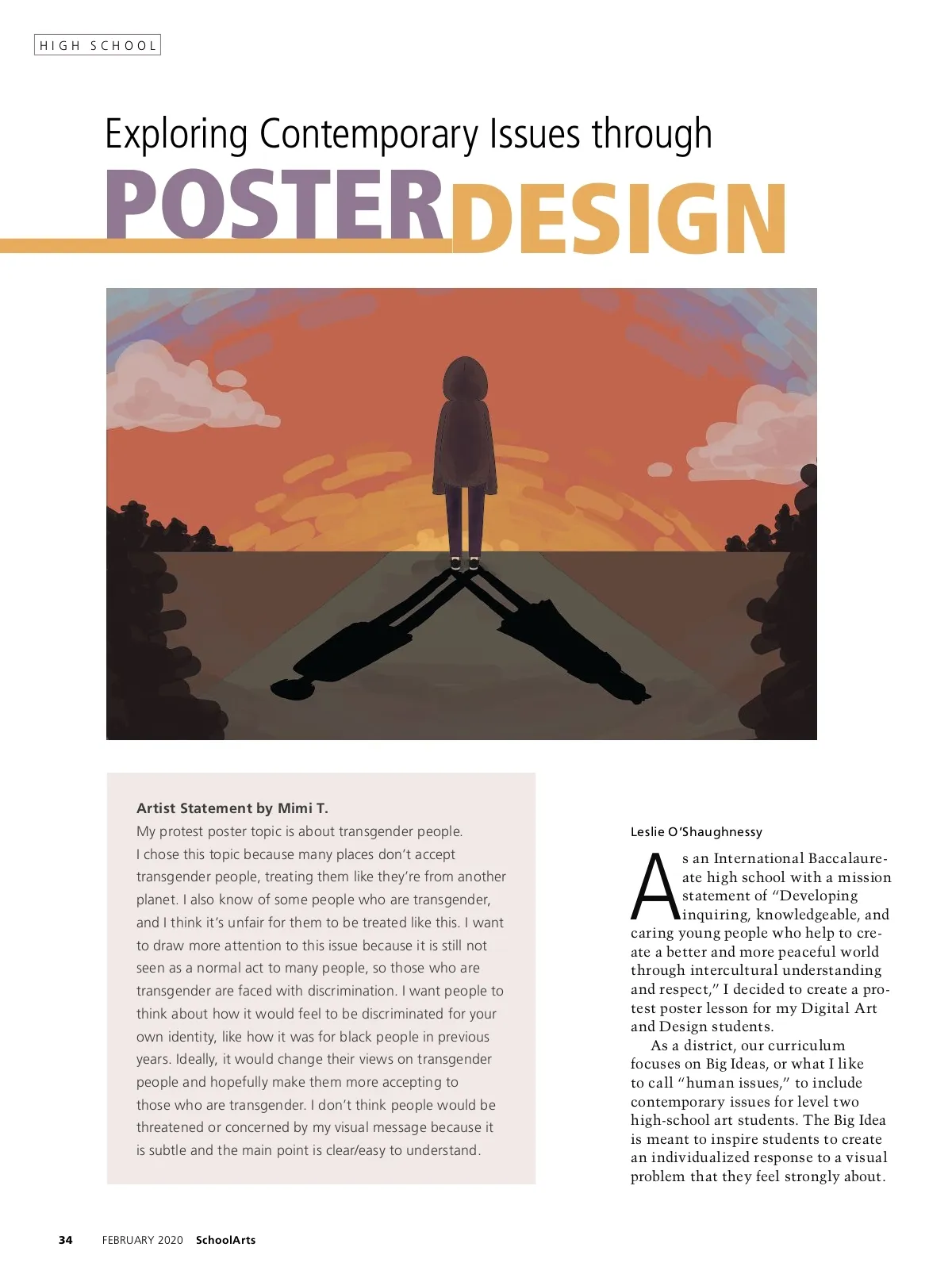
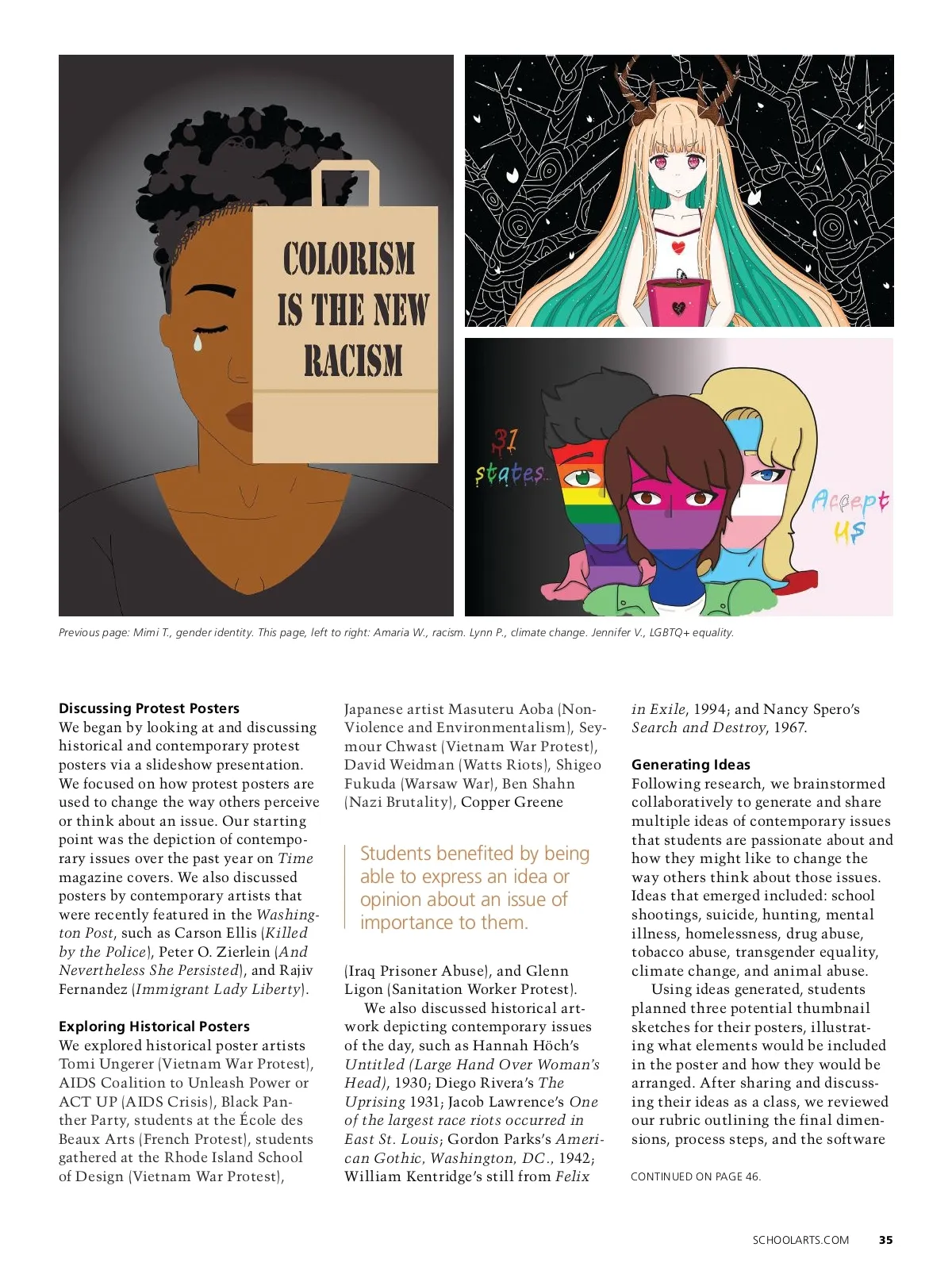
Previous page: Mimi T., gender identity. This page, left to right: Amaria W., racism. Lynn P., climate change. Jennifer V., LGBTQ+ equality. Discussing Protest Posters We began by looking at and discussing historical and contemporary protest posters via a slideshow presentation. We focused on how protest posters are used to change the way others perceive or think about an issue. Our starting point was the depiction of contempo-rary issues over the past year on Time magazine covers. We also discussed posters by contemporary artists that were recently featured in the Washing-ton Post , such as Carson Ellis ( Killed by the Police ), Peter O. Zierlein ( And Nevertheless She Persisted ), and Rajiv Fernandez ( Immigrant Lady Liberty ). Exploring Historical Posters We explored historical poster artists Tomi Ungerer (Vietnam War Protest), AIDS Coalition to Unleash Power or ACT UP (AIDS Crisis), Black Pan-ther Party, students at the École des Beaux Arts (French Protest), students gathered at the Rhode Island School of Design (Vietnam War Protest), Japanese artist Masuteru Aoba (Non-Violence and Environmentalism), Sey-mour Chwast (Vietnam War Protest), David Weidman (Watts Riots), Shigeo Fukuda (Warsaw War), Ben Shahn (Nazi Brutality), Copper Greene in Exile , 1994; and Nancy Spero’s Search and Destroy , 1967. Generating Ideas Following research, we brainstormed collaboratively to generate and share multiple ideas of contemporary issues that students are passionate about and how they might like to change the way others think about those issues. Ideas that emerged included: school shootings, suicide, hunting, mental illness, homelessness, drug abuse, tobacco abuse, transgender equality, climate change, and animal abuse. Using ideas generated, students planned three potential thumbnail sketches for their posters, illustrat-ing what elements would be included in the poster and how they would be arranged. After sharing and discuss-ing their ideas as a class, we reviewed our rubric outlining the final dimen-sions, process steps, and the software CONTINUED ON PAGE 46. Students benefited by being able to express an idea or opinion about an issue of importance to them. (Iraq Prisoner Abuse), and Glenn Ligon (Sanitation Worker Protest). We also discussed historical art-work depicting contemporary issues of the day, such as Hannah Höch’s Untitled (Large Hand Over Woman’s Head) , 1930; Diego Rivera’s The Uprising 1931; Jacob Lawrence’s One of the largest race riots occurred in East St. Louis ; Gordon Parks’s Ameri-can Gothic, Washington, DC., 1942; William Kentridge’s still from Felix SCHOOLARTS.COM 35
School Arts Magazine February 2020: Page 37