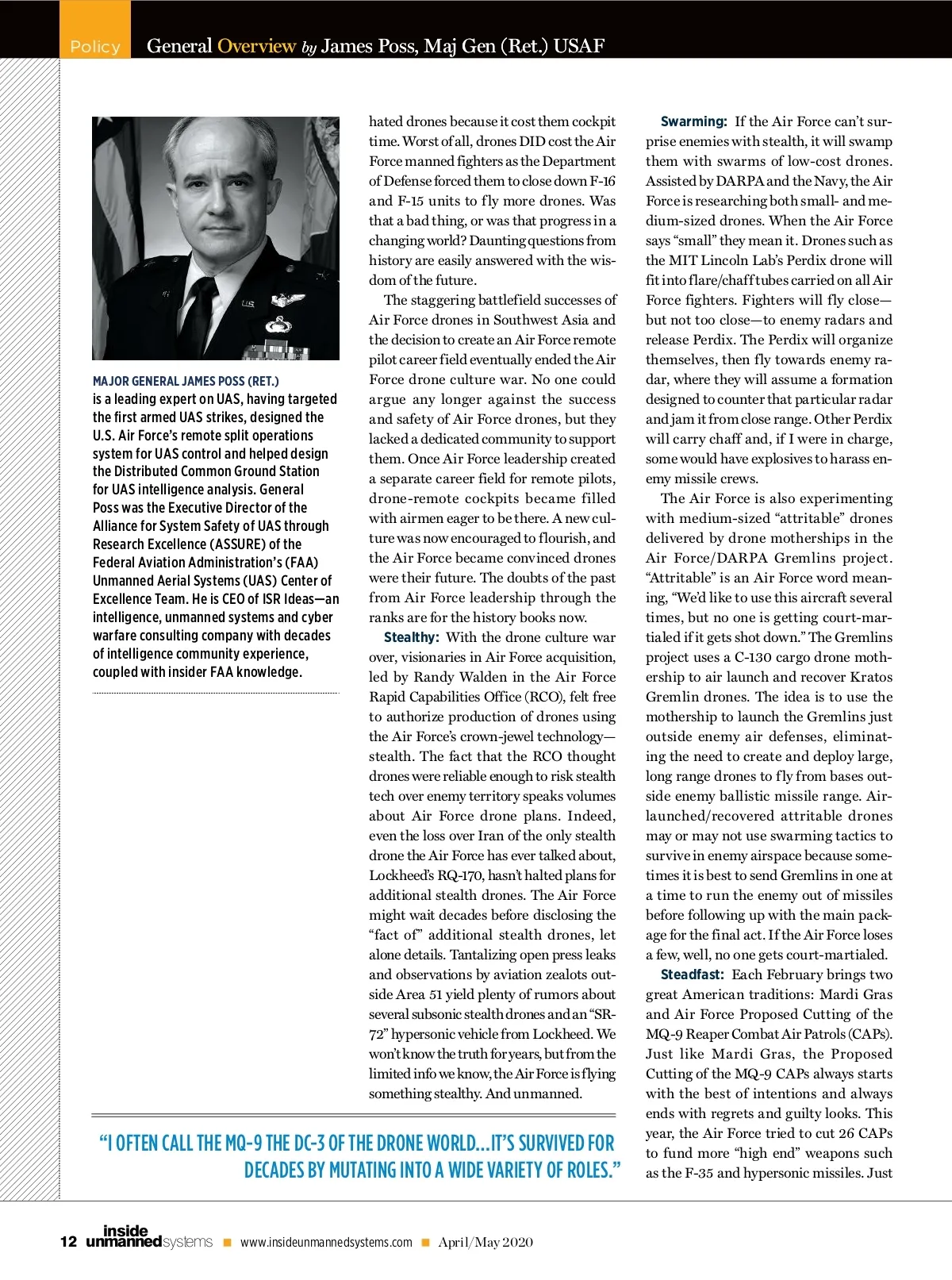
Policy General Overview by James Poss, Maj Gen (Ret.) USAF MAJOR GENERAL JAMES POSS (RET.) is a leading expert on UAS, having targeted the first armed UAS strikes, designed the U.S. Air Force’s remote split operations system for UAS control and helped design the Distributed Common Ground Station for UAS intelligence analysis. General Poss was the Executive Director of the Alliance for System Safety of UAS through Research Excellence (ASSURE) of the Federal Aviation Administration’s (FAA) Unmanned Aerial Systems (UAS) Center of Excellence Team. He is CEO of ISR Ideas—an intelligence, unmanned systems and cyber warfare consulting company with decades of intelligence community experience, coupled with insider FAA knowledge. hated drones because it cost them cockpit time. Worst of all, drones DID cost the Air Force manned fighters as the Department of Defense forced them to close down F-16 and F-15 units to fly more drones. Was that a bad thing, or was that progress in a changing world? Daunting questions from history are easily answered with the wis-dom of the future. The staggering battlefield successes of Air Force drones in Southwest Asia and the decision to create an Air Force remote pilot career field eventually ended the Air Force drone culture war. No one could argue any longer against the success and safety of Air Force drones, but they lacked a dedicated community to support them. Once Air Force leadership created a separate career field for remote pilots, drone-remote cockpits became filled with airmen eager to be there. A new cul-ture was now encouraged to flourish, and the Air Force became convinced drones were their future. The doubts of the past from Air Force leadership through the ranks are for the history books now. Stealthy: With the drone culture war over, visionaries in Air Force acquisition, led by Randy Walden in the Air Force Rapid Capabilities Office (RCO), felt free to authorize production of drones using the Air Force’s crown-jewel technology— stealth. The fact that the RCO thought drones were reliable enough to risk stealth tech over enemy territory speaks volumes about Air Force drone plans. Indeed, even the loss over Iran of the only stealth drone the Air Force has ever talked about, Lockheed’s RQ-170, hasn’t halted plans for additional stealth drones. The Air Force might wait decades before disclosing the “fact of” additional stealth drones, let alone details. Tantalizing open press leaks and observations by aviation zealots out-side Area 51 yield plenty of rumors about several subsonic stealth drones and an “SR-72” hypersonic vehicle from Lockheed. We won’t know the truth for years, but from the limited info we know, the Air Force is flying something stealthy. And unmanned. “I OFTEN CALL THE MQ-9 THE DC-3 OF THE DRONE WORLD…IT’S SURVIVED FOR DECADES BY MUTATING INTO A WIDE VARIETY OF ROLES.” inside 12 unmanned systems www.insideunmannedsystems.com April/May 2020 Swarming: If the Air Force can’t sur-prise enemies with stealth, it will swamp them with swarms of low-cost drones. Assisted by DARPA and the Navy, the Air Force is researching both small-and me-dium-sized drones. When the Air Force says “small” they mean it. Drones such as the MIT Lincoln Lab’s Perdix drone will fit into flare/chaff tubes carried on all Air Force fighters. Fighters will fly close— but not too close—to enemy radars and release Perdix. The Perdix will organize themselves, then fly towards enemy ra-dar, where they will assume a formation designed to counter that particular radar and jam it from close range. Other Perdix will carry chaff and, if I were in charge, some would have explosives to harass en-emy missile crews. The Air Force is also experimenting with medium-sized “attritable” drones delivered by drone motherships in the Air Force/DARPA Gremlins project. “Attritable” is an Air Force word mean-ing, “We’d like to use this aircraft several times, but no one is getting court-mar-tialed if it gets shot down.” The Gremlins project uses a C-130 cargo drone moth-ership to air launch and recover Kratos Gremlin drones. The idea is to use the mothership to launch the Gremlins just outside enemy air defenses, eliminat-ing the need to create and deploy large, long range drones to fly from bases out-side enemy ballistic missile range. Air-launched/recovered attritable drones may or may not use swarming tactics to survive in enemy airspace because some-times it is best to send Gremlins in one at a time to run the enemy out of missiles before following up with the main pack-age for the final act. If the Air Force loses a few, well, no one gets court-martialed. Steadfast: Each February brings two great American traditions: Mardi Gras and Air Force Proposed Cutting of the MQ-9 Reaper Combat Air Patrols (CAPs). Just like Mardi Gras, the Proposed Cutting of the MQ-9 CAPs always starts with the best of intentions and always ends with regrets and guilty looks. This year, the Air Force tried to cut 26 CAPs to fund more “high end” weapons such as the F-35 and hypersonic missiles. Just
Inside Unmanned Systems April/May 2020: Page 12