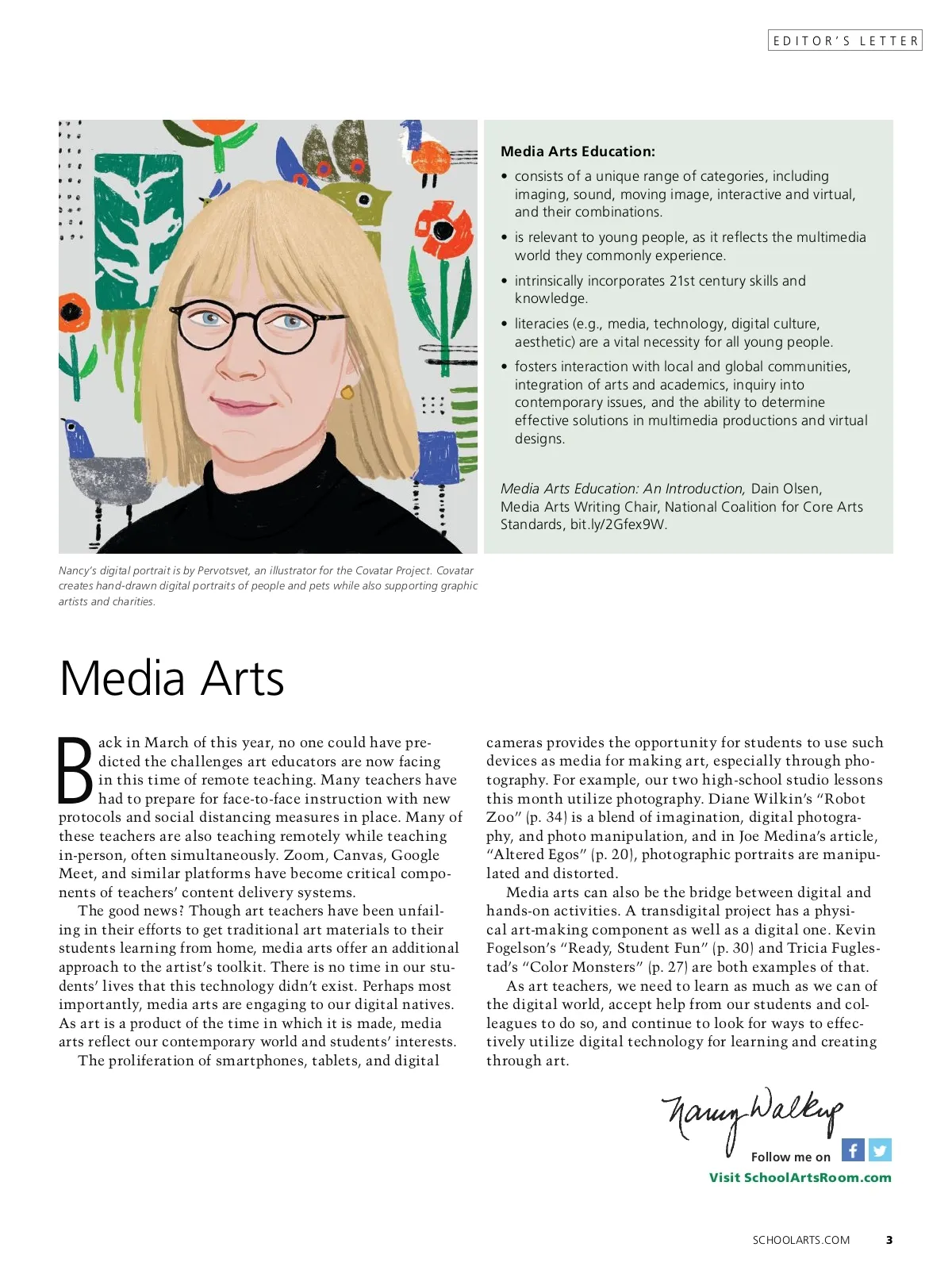
EDITOR’S LETTER Media Arts Education: • consists of a unique range of categories, including imaging, sound, moving image, interactive and virtual, and their combinations. • is relevant to young people, as it reflects the multimedia world they commonly experience. • intrinsically incorporates 21st century skills and knowledge. • literacies (e.g., media, technology, digital culture, aesthetic) are a vital necessity for all young people. • fosters interaction with local and global communities, integration of arts and academics, inquiry into contemporary issues, and the ability to determine effective solutions in multimedia productions and virtual designs. Media Arts Education: An Introduction, Dain Olsen, Media Arts Writing Chair, National Coalition for Core Arts Standards, bit.ly/2Gfex9W. Nancy’s digital portrait is by Pervotsvet, an illustrator for the Covatar Project. Covatar creates hand-drawn digital portraits of people and pets while also supporting graphic artists and charities. Media Arts B ack in March of this year, no one could have pre-dicted the challenges art educators are now facing in this time of remote teaching. Many teachers have had to prepare for face-to-face instruction with new protocols and social distancing measures in place. Many of these teachers are also teaching remotely while teaching in-person, often simultaneously. Zoom, Canvas, Google Meet, and similar platforms have become critical compo-nents of teachers’ content delivery systems. The good news? Though art teachers have been unfail-ing in their efforts to get traditional art materials to their students learning from home, media arts offer an additional approach to the artist’s toolkit. There is no time in our stu-dents’ lives that this technology didn’t exist. Perhaps most importantly, media arts are engaging to our digital natives. As art is a product of the time in which it is made, media arts reflect our contemporary world and students’ interests. The proliferation of smartphones, tablets, and digital cameras provides the opportunity for students to use such devices as media for making art, especially through pho-tography. For example, our two high-school studio lessons this month utilize photography. Diane Wilkin’s “Robot Zoo” (p. 34) is a blend of imagination, digital photogra-phy, and photo manipulation, and in Joe Medina’s article, “Altered Egos” (p. 20), photographic portraits are manipu-lated and distorted. Media arts can also be the bridge between digital and hands-on activities. A transdigital project has a physi-cal art-making component as well as a digital one. Kevin Fogelson’s “Ready, Student Fun” (p. 30) and Tricia Fugles-tad’s “Color Monsters” (p. 27) are both examples of that. As art teachers, we need to learn as much as we can of the digital world, accept help from our students and col-leagues to do so, and continue to look for ways to effec-tively utilize digital technology for learning and creating through art. Follow me on Visit SchoolArtsRoom.com SCHOOLARTS.COM 3
School Arts Magazine December 2020: Page 5