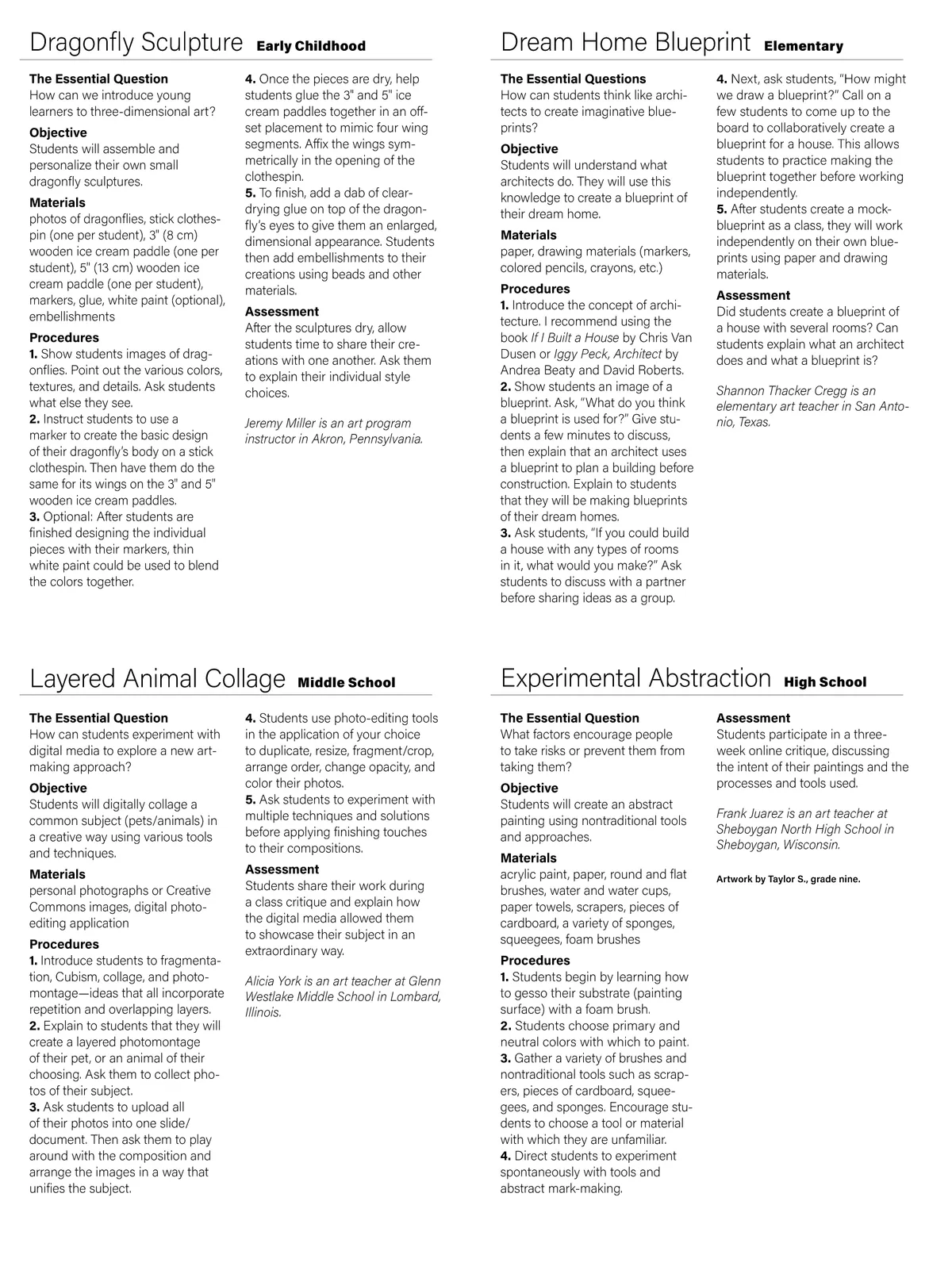
Dragonfly Sculpture The Essential Question How can we introduce young learners to three-dimensional art? Objective Students will assemble and personalize their own small dragonfly sculptures. Materials photos of dragonflies, stick clothes-pin (one per student), 3" (8 cm) wooden ice cream paddle (one per student), 5" (13 cm) wooden ice cream paddle (one per student), markers, glue, white paint (optional), embellishments Procedures 1. Show students images of drag-onflies. Point out the various colors, textures, and details. Ask students what else they see. 2. Instruct students to use a marker to create the basic design of their dragonfly’s body on a stick clothespin. Then have them do the same for its wings on the 3" and 5" wooden ice cream paddles. 3. Optional: After students are finished designing the individual pieces with their markers, thin white paint could be used to blend the colors together. Early Childhood 4. Once the pieces are dry, help students glue the 3" and 5" ice cream paddles together in an off-set placement to mimic four wing segments. Affix the wings sym-metrically in the opening of the clothespin. 5. To finish, add a dab of clear-drying glue on top of the dragon-fly’s eyes to give them an enlarged, dimensional appearance. Students then add embellishments to their creations using beads and other materials. Assessment After the sculptures dry, allow students time to share their cre-ations with one another. Ask them to explain their individual style choices. Jeremy Miller is an art program instructor in Akron, Pennsylvania. Dream Home Blueprint The Essential Questions How can students think like archi-tects to create imaginative blue-prints? Objective Students will understand what architects do. They will use this knowledge to create a blueprint of their dream home. Materials paper, drawing materials (markers, colored pencils, crayons, etc.) Procedures 1. Introduce the concept of archi-tecture. I recommend using the book If I Built a House by Chris Van Dusen or Iggy Peck, Architect by Andrea Beaty and David Roberts. 2. Show students an image of a blueprint. Ask, “What do you think a blueprint is used for?” Give stu-dents a few minutes to discuss, then explain that an architect uses a blueprint to plan a building before construction. Explain to students that they will be making blueprints of their dream homes. 3. Ask students, “If you could build a house with any types of rooms in it, what would you make?” Ask students to discuss with a partner before sharing ideas as a group. Elementary 4. Next, ask students, “How might we draw a blueprint?” Call on a few students to come up to the board to collaboratively create a blueprint for a house. This allows students to practice making the blueprint together before working independently. 5. After students create a mock-blueprint as a class, they will work independently on their own blue-prints using paper and drawing materials. Assessment Did students create a blueprint of a house with several rooms? Can students explain what an architect does and what a blueprint is? Shannon Thacker Cregg is an elementary art teacher in San Anto-nio, Texas. Layered Animal Collage The Essential Question How can students experiment with digital media to explore a new art-making approach? Objective Students will digitally collage a common subject (pets/animals) in a creative way using various tools and techniques. Materials personal photographs or Creative Commons images, digital photo-editing application Procedures 1. Introduce students to fragmenta-tion, Cubism, collage, and photo-montage—ideas that all incorporate repetition and overlapping layers. 2. Explain to students that they will create a layered photomontage of their pet, or an animal of their choosing. Ask them to collect pho-tos of their subject. 3. Ask students to upload all of their photos into one slide/ document. Then ask them to play around with the composition and arrange the images in a way that unifies the subject. Middle School Experimental Abstraction The Essential Question What factors encourage people to take risks or prevent them from taking them? Objective Students will create an abstract painting using nontraditional tools and approaches. Materials acrylic paint, paper, round and flat brushes, water and water cups, paper towels, scrapers, pieces of cardboard, a variety of sponges, squeegees, foam brushes Procedures 1. Students begin by learning how to gesso their substrate (painting surface) with a foam brush. 2. Students choose primary and neutral colors with which to paint. 3. Gather a variety of brushes and nontraditional tools such as scrap-ers, pieces of cardboard, squee-gees, and sponges. Encourage stu-dents to choose a tool or material with which they are unfamiliar. 4. Direct students to experiment spontaneously with tools and abstract mark-making. High School 4. Students use photo-editing tools in the application of your choice to duplicate, resize, fragment/crop, arrange order, change opacity, and color their photos. 5. Ask students to experiment with multiple techniques and solutions before applying finishing touches to their compositions. Assessment Students share their work during a class critique and explain how the digital media allowed them to showcase their subject in an extraordinary way. Alicia York is an art teacher at Glenn Westlake Middle School in Lombard, Illinois. Assessment Students participate in a three-week online critique, discussing the intent of their paintings and the processes and tools used. Frank Juarez is an art teacher at Sheboygan North High School in Sheboygan, Wisconsin. Artwork by Taylor S., grade nine.
School Arts Magazine September 2021: Page 10