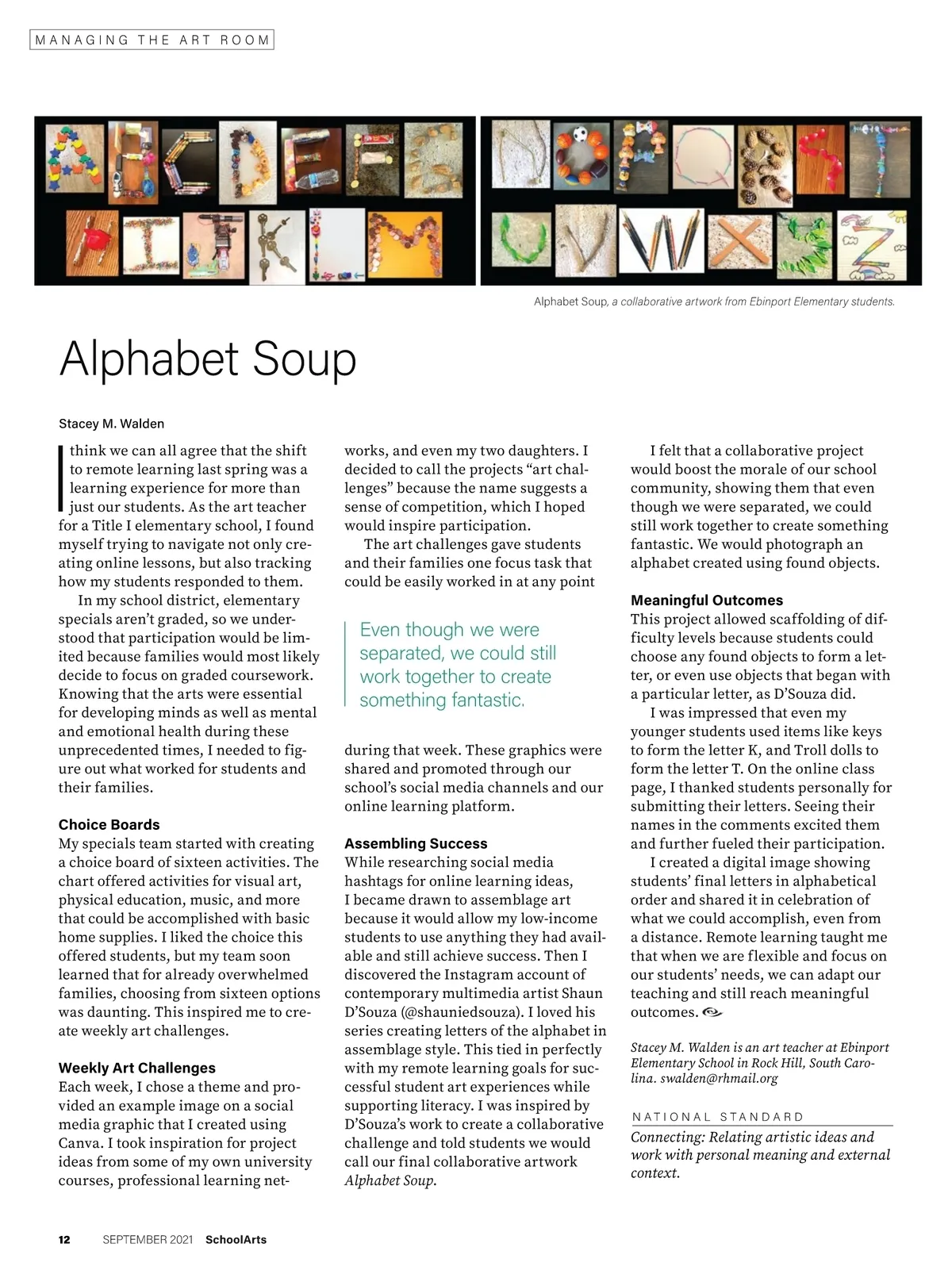
MANAGING THE ART ROOM Alphabet Soup , a collaborative artwork from Ebinport Elementary students. Alphabet Soup I Stacey M. Walden think we can all agree that the shift to remote learning last spring was a learning experience for more than just our students. As the art teacher for a Title I elementary school, I found myself trying to navigate not only cre-ating online lessons, but also tracking how my students responded to them. In my school district, elementary specials aren’t graded, so we under-stood that participation would be lim-ited because families would most likely decide to focus on graded coursework. Knowing that the arts were essential for developing minds as well as mental and emotional health during these unprecedented times, I needed to fig-ure out what worked for students and their families. works, and even my two daughters. I decided to call the projects “art chal-lenges” because the name suggests a sense of competition, which I hoped would inspire participation. The art challenges gave students and their families one focus task that could be easily worked in at any point I felt that a collaborative project would boost the morale of our school community, showing them that even though we were separated, we could still work together to create something fantastic. We would photograph an alphabet created using found objects. Meaningful Outcomes This project allowed scaffolding of dif-ficulty levels because students could choose any found objects to form a let-ter, or even use objects that began with a particular letter, as D’Souza did. I was impressed that even my younger students used items like keys to form the letter K, and Troll dolls to form the letter T. On the online class page, I thanked students personally for submitting their letters. Seeing their names in the comments excited them and further fueled their participation. I created a digital image showing students’ final letters in alphabetical order and shared it in celebration of what we could accomplish, even from a distance. Remote learning taught me that when we are flexible and focus on our students’ needs, we can adapt our teaching and still reach meaningful outcomes. Stacey M. Walden is an art teacher at Ebinport Elementary School in Rock Hill, South Caro-lina. swalden@rhmail.org NATIONAL STANDARD Even though we were separated, we could still work together to create something fantastic. during that week. These graphics were shared and promoted through our school’s social media channels and our online learning platform. Assembling Success While researching social media hashtags for online learning ideas, I became drawn to assemblage art because it would allow my low-income students to use anything they had avail-able and still achieve success. Then I discovered the Instagram account of contemporary multimedia artist Shaun D’Souza (@shauniedsouza). I loved his series creating letters of the alphabet in assemblage style. This tied in perfectly with my remote learning goals for suc-cessful student art experiences while supporting literacy. I was inspired by D’Souza’s work to create a collaborative challenge and told students we would call our final collaborative artwork Alphabet Soup . Choice Boards My specials team started with creating a choice board of sixteen activities. The chart offered activities for visual art, physical education, music, and more that could be accomplished with basic home supplies. I liked the choice this offered students, but my team soon learned that for already overwhelmed families, choosing from sixteen options was daunting. This inspired me to cre-ate weekly art challenges. Weekly Art Challenges Each week, I chose a theme and pro-vided an example image on a social media graphic that I created using Canva. I took inspiration for project ideas from some of my own university courses, professional learning net-Connecting: Relating artistic ideas and work with personal meaning and external context. 12 SEPTEMBER 2021 SchoolArts
School Arts Magazine September 2021: Page 12