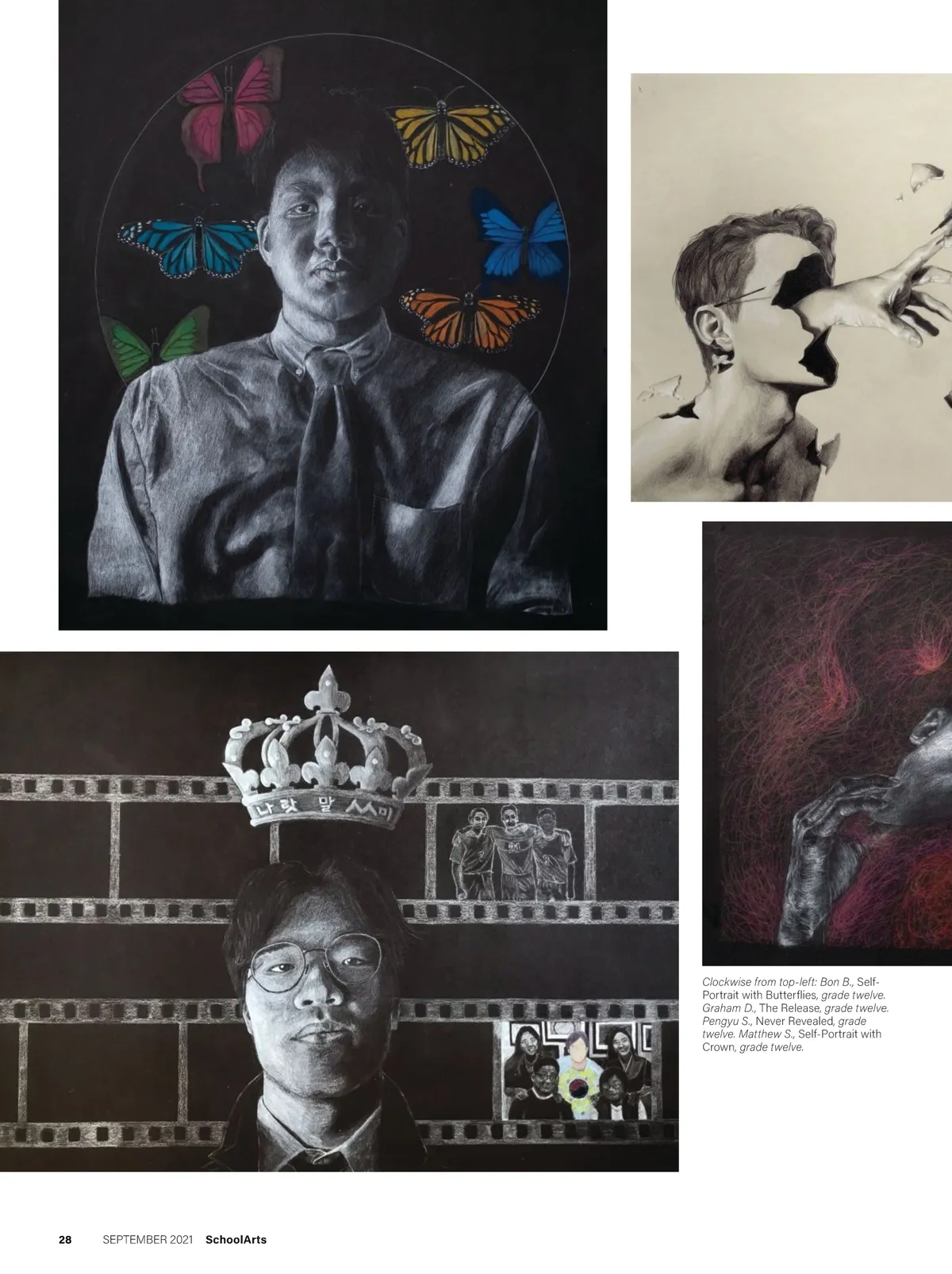
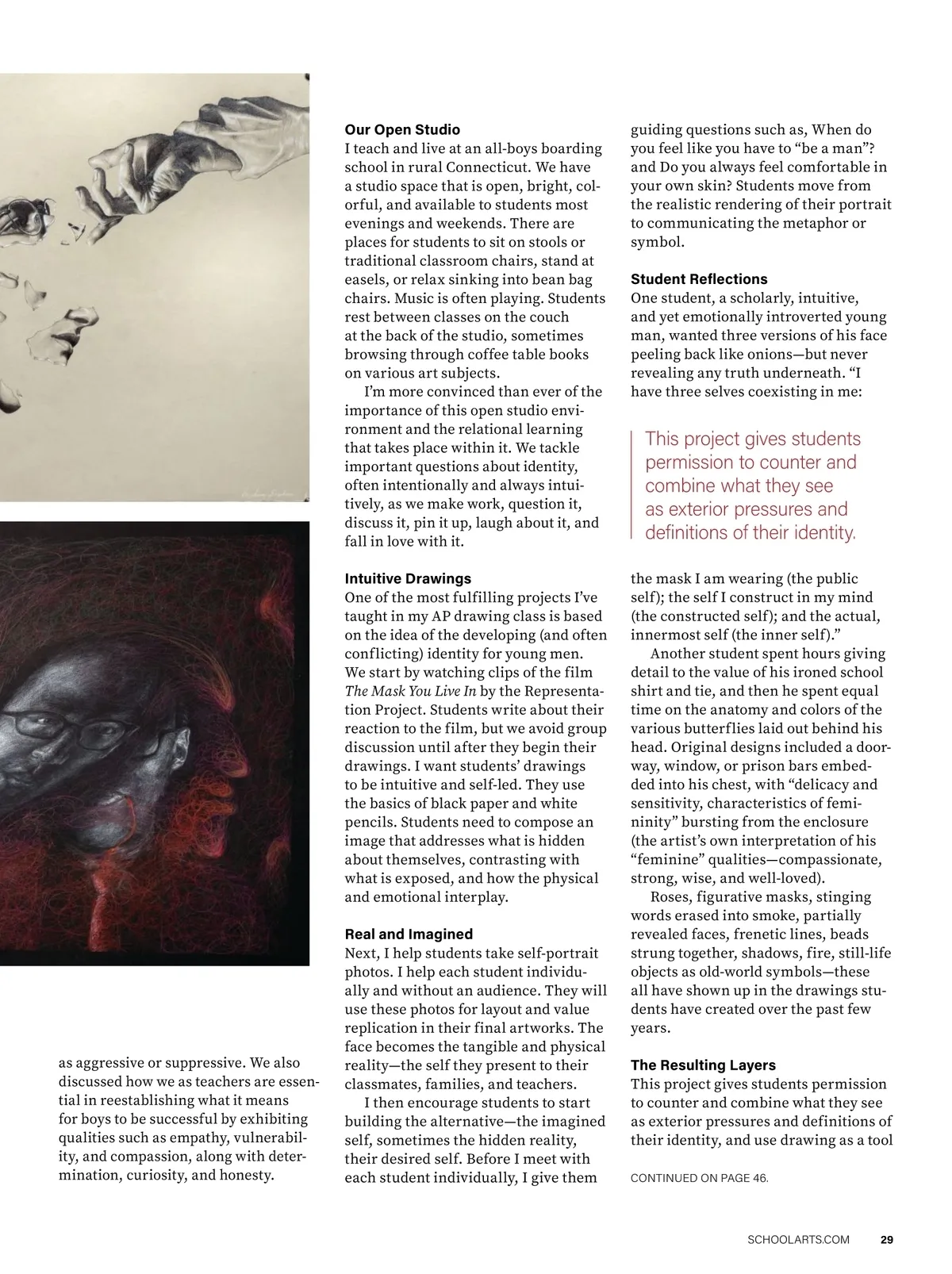
Our Open Studio I teach and live at an all-boys boarding school in rural Connecticut. We have a studio space that is open, bright, col-orful, and available to students most evenings and weekends. There are places for students to sit on stools or traditional classroom chairs, stand at easels, or relax sinking into bean bag chairs. Music is often playing. Students rest between classes on the couch at the back of the studio, sometimes browsing through coffee table books on various art subjects. I’m more convinced than ever of the importance of this open studio envi-ronment and the relational learning that takes place within it. We tackle important questions about identity, often intentionally and always intui-tively, as we make work, question it, discuss it, pin it up, laugh about it, and fall in love with it. Intuitive Drawings One of the most fulfilling projects I’ve taught in my AP drawing class is based on the idea of the developing (and often conflicting) identity for young men. We start by watching clips of the film The Mask You Live In by the Representa-tion Project. Students write about their reaction to the film, but we avoid group discussion until after they begin their drawings. I want students’ drawings to be intuitive and self-led. They use the basics of black paper and white pencils. Students need to compose an image that addresses what is hidden about themselves, contrasting with what is exposed, and how the physical and emotional interplay. Real and Imagined Next, I help students take self-portrait photos. I help each student individu-ally and without an audience. They will use these photos for layout and value replication in their final artworks. The face becomes the tangible and physical reality—the self they present to their classmates, families, and teachers. I then encourage students to start building the alternative—the imagined self, sometimes the hidden reality, their desired self. Before I meet with each student individually, I give them guiding questions such as, When do you feel like you have to “be a man”? and Do you always feel comfortable in your own skin? Students move from the realistic rendering of their portrait to communicating the metaphor or symbol. Student Reflections One student, a scholarly, intuitive, and yet emotionally introverted young man, wanted three versions of his face peeling back like onions—but never revealing any truth underneath. “I have three selves coexisting in me: This project gives students permission to counter and combine what they see as exterior pressures and definitions of their identity. the mask I am wearing (the public self); the self I construct in my mind (the constructed self); and the actual, innermost self (the inner self).” Another student spent hours giving detail to the value of his ironed school shirt and tie, and then he spent equal time on the anatomy and colors of the various butterflies laid out behind his head. Original designs included a door-way, window, or prison bars embed-ded into his chest, with “delicacy and sensitivity, characteristics of femi-ninity” bursting from the enclosure (the artist’s own interpretation of his “feminine” qualities—compassionate, strong, wise, and well-loved). Roses, figurative masks, stinging words erased into smoke, partially revealed faces, frenetic lines, beads strung together, shadows, fire, still-life objects as old-world symbols—these all have shown up in the drawings stu-dents have created over the past few years. The Resulting Layers This project gives students permission to counter and combine what they see as exterior pressures and definitions of their identity, and use drawing as a tool CONTINUED ON PAGE 46. as aggressive or suppressive. We also discussed how we as teachers are essen-tial in reestablishing what it means for boys to be successful by exhibiting qualities such as empathy, vulnerabil-ity, and compassion, along with deter-mination, curiosity, and honesty. SCHOOLARTS.COM 29
School Arts Magazine September 2021: Page 29