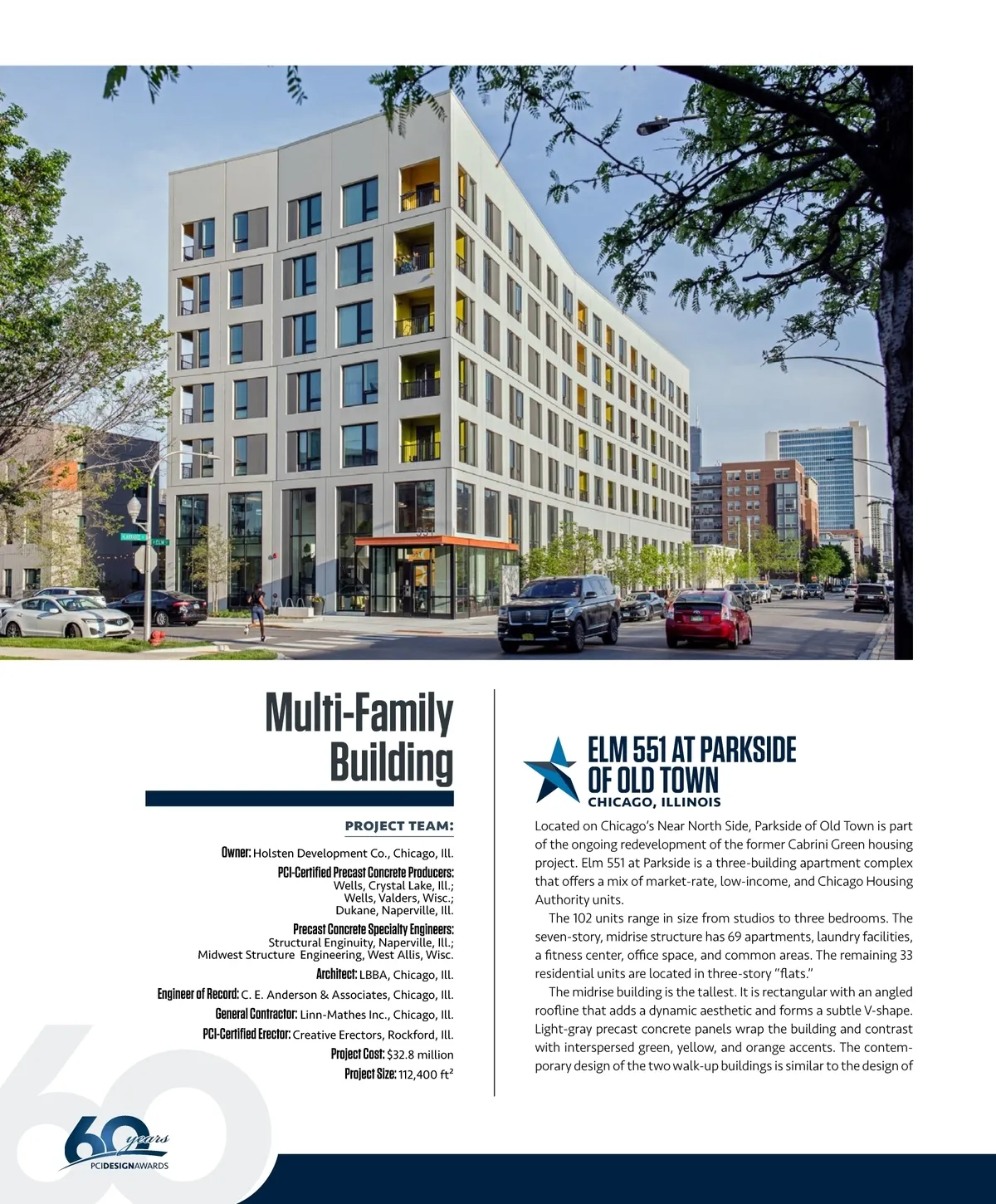
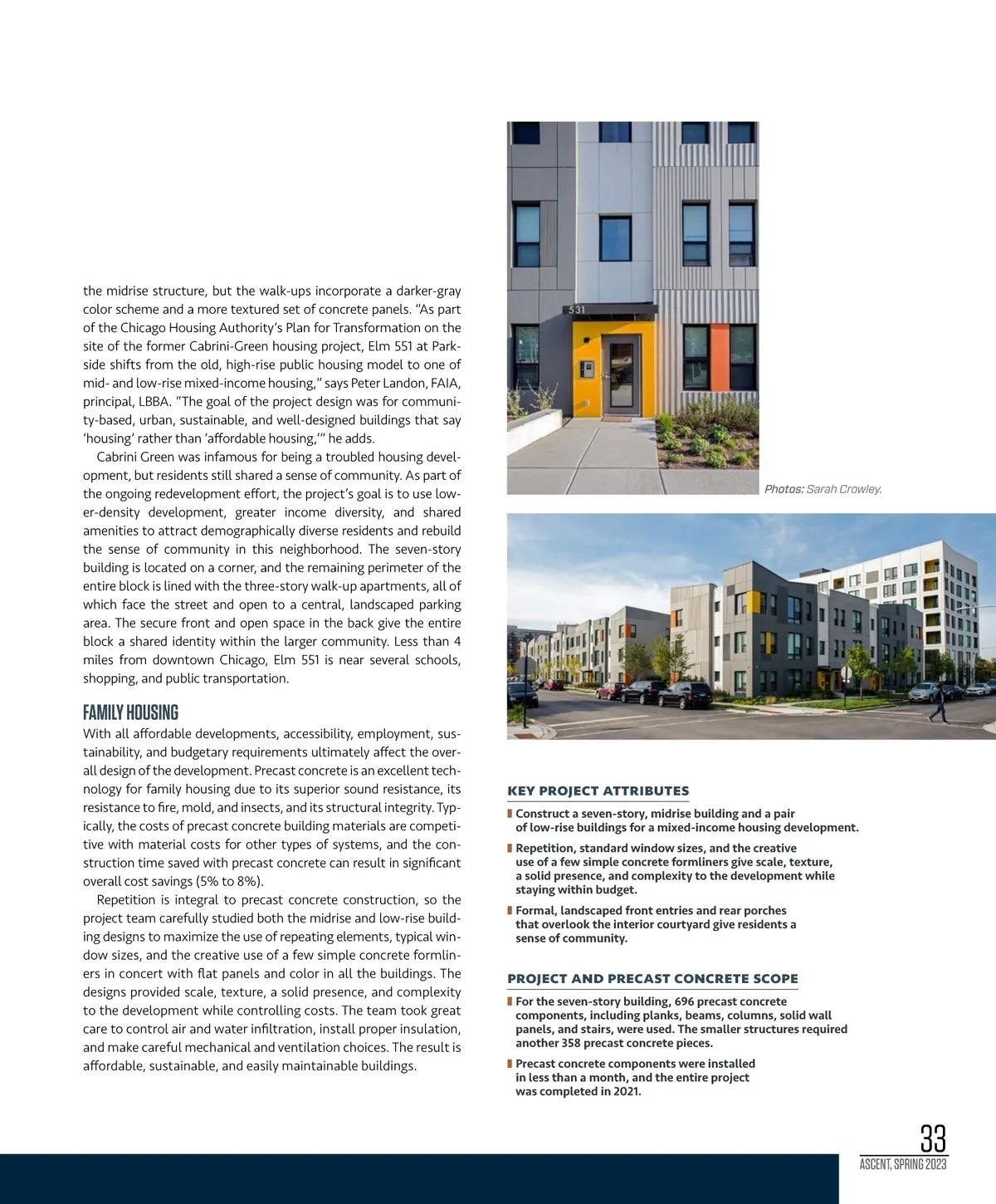
the midrise structure, but the walk-ups incorporate a darker-gray color scheme and a more textured set of concrete panels. “As part of the Chicago Housing Authority’s Plan for Transformation on the site of the former Cabrini-Green housing project, Elm 551 at Park-side shifts from the old, high-rise public housing model to one of mid-and low-rise mixed-income housing,” says Peter Landon, FAIA, principal, LBBA. “The goal of the project design was for communi-ty-based, urban, sustainable, and well-designed buildings that say ‘housing’ rather than ‘affordable housing,’” he adds. Cabrini Green was infamous for being a troubled housing devel-opment, but residents still shared a sense of community. As part of the ongoing redevelopment effort, the project’s goal is to use low-er-density development, greater income diversity, and shared amenities to attract demographically diverse residents and rebuild the sense of community in this neighborhood. The seven-story building is located on a corner, and the remaining perimeter of the entire block is lined with the three-story walk-up apartments, all of which face the street and open to a central, landscaped parking area. The secure front and open space in the back give the entire block a shared identity within the larger community. Less than 4 miles from downtown Chicago, Elm 551 is near several schools, shopping, and public transportation. Photos: Sarah Crowley. FAMILY HOUSING With all affordable developments, accessibility, employment, sus-tainability, and budgetary requirements ultimately affect the over-all design of the development. Precast concrete is an excellent tech-nology for family housing due to its superior sound resistance, its resistance to fire, mold, and insects, and its structural integrity. Typ-ically, the costs of precast concrete building materials are competi-tive with material costs for other types of systems, and the con-struction time saved with precast concrete can result in significant overall cost savings (5% to 8%). Repetition is integral to precast concrete construction, so the project team carefully studied both the midrise and low-rise build-ing designs to maximize the use of repeating elements, typical win-dow sizes, and the creative use of a few simple concrete formlin-ers in concert with flat panels and color in all the buildings. The designs provided scale, texture, a solid presence, and complexity to the development while controlling costs. The team took great care to control air and water infiltration, install proper insulation, and make careful mechanical and ventilation choices. The result is affordable, sustainable, and easily maintainable buildings. Key Project attributes ❚ Construct a seven-story, midrise building and a pair of low-rise buildings for a mixed-income housing development. ❚ Repetition, standard window sizes, and the creative use of a few simple concrete formliners give scale, texture, a solid presence, and complexity to the development while staying within budget. ❚ Formal, landscaped front entries and rear porches that overlook the interior courtyard give residents a sense of community. Project and Precast concrete scoPe ❚ For the seven-story building, 696 precast concrete components, including planks, beams, columns, solid wall panels, and stairs, were used. The smaller structures required another 358 precast concrete pieces. ❚ Precast concrete components were installed in less than a month, and the entire project was completed in 2021. ASCENT, SPRING 2023 33
Ascent Spring 2023: Page 33