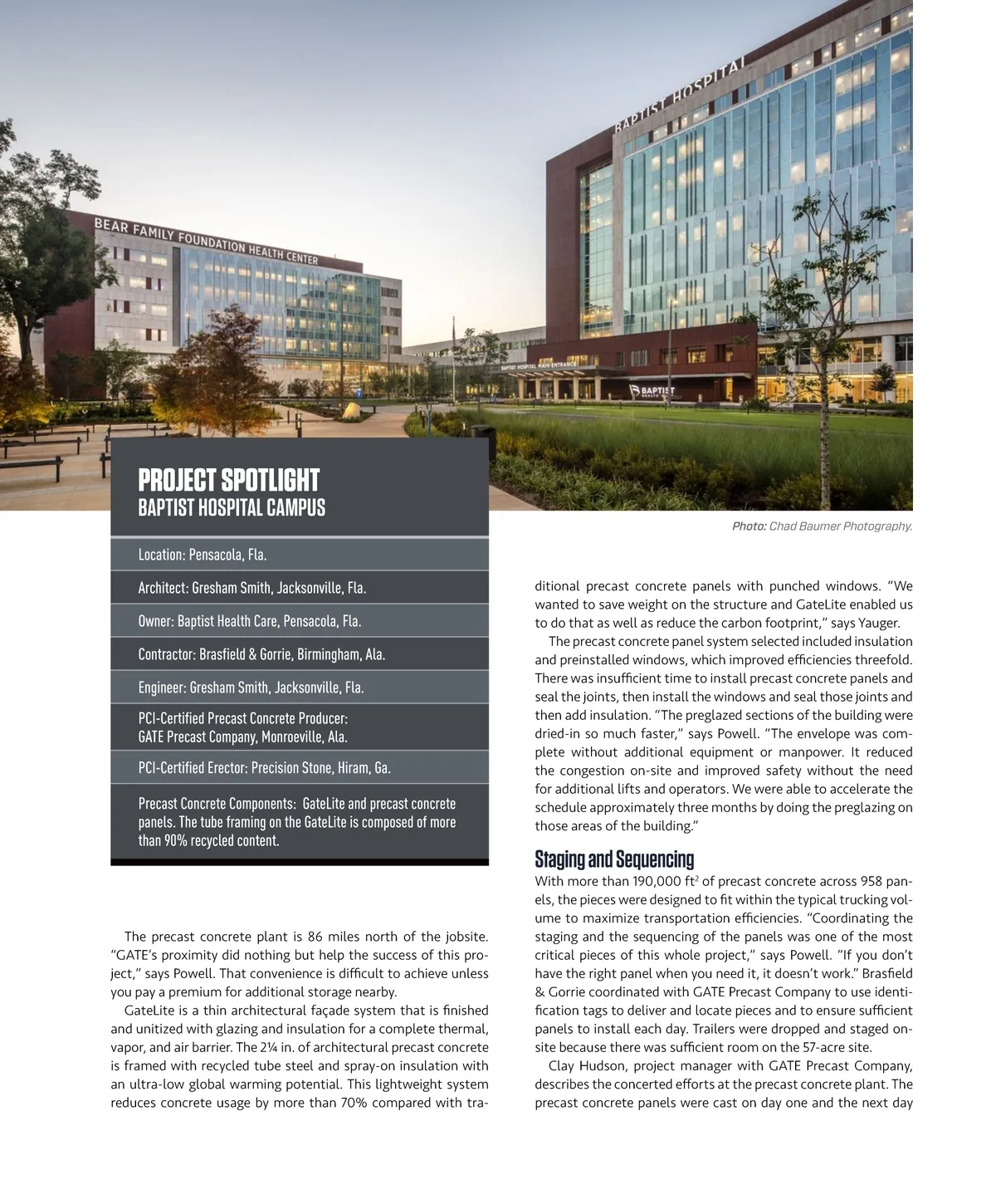
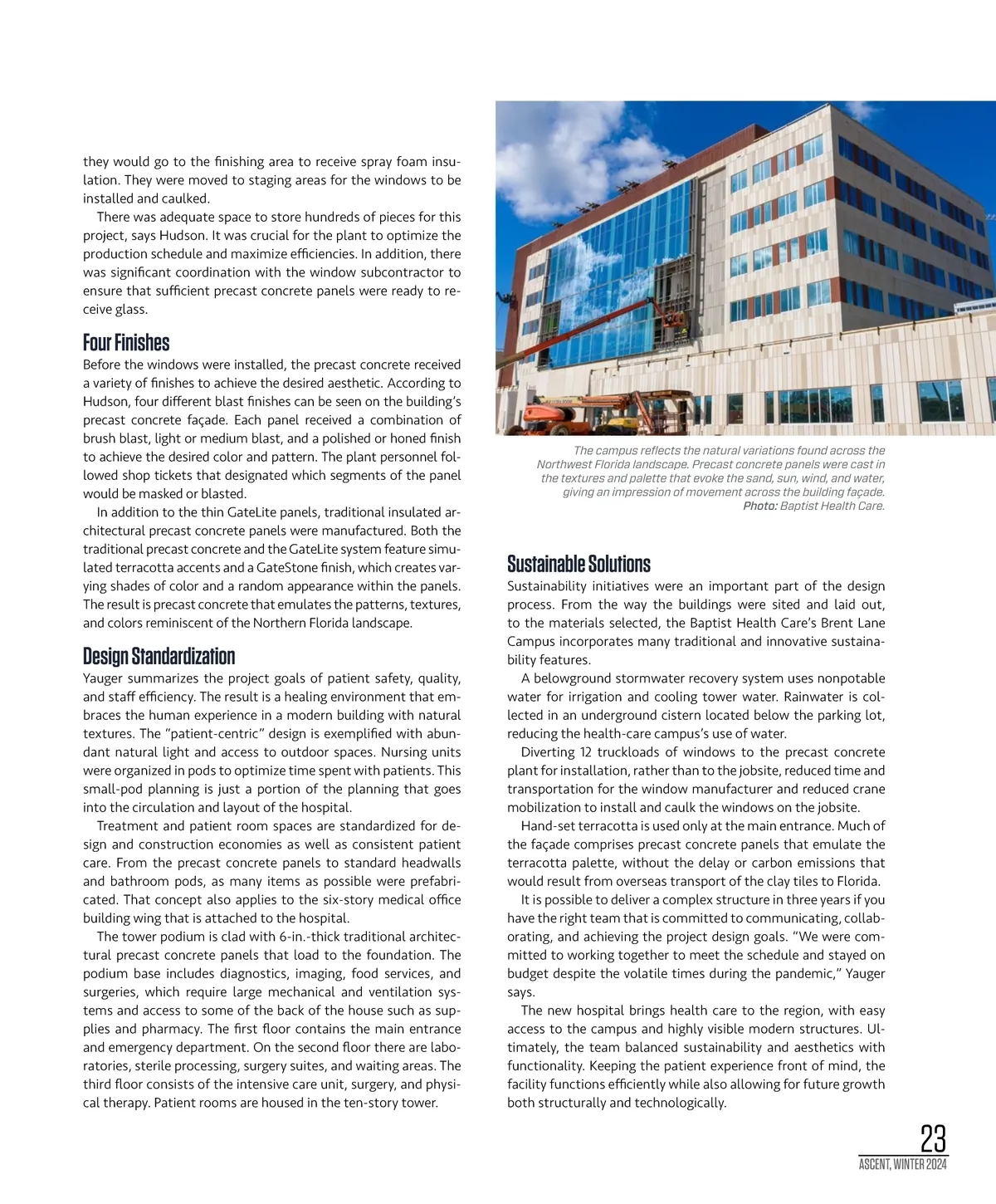
they would go to the finishing area to receive spray foam insu-lation. They were moved to staging areas for the windows to be installed and caulked. There was adequate space to store hundreds of pieces for this project, says Hudson. It was crucial for the plant to optimize the production schedule and maximize efficiencies. In addition, there was significant coordination with the window subcontractor to ensure that sufficient precast concrete panels were ready to re-ceive glass. Four Finishes Before the windows were installed, the precast concrete received a variety of finishes to achieve the desired aesthetic. According to Hudson, four different blast finishes can be seen on the building’s precast concrete façade. Each panel received a combination of brush blast, light or medium blast, and a polished or honed finish to achieve the desired color and pattern. The plant personnel fol-lowed shop tickets that designated which segments of the panel would be masked or blasted. In addition to the thin GateLite panels, traditional insulated ar-chitectural precast concrete panels were manufactured. Both the traditional precast concrete and the GateLite system feature simu-lated terracotta accents and a GateStone finish, which creates var-ying shades of color and a random appearance within the panels. The result is precast concrete that emulates the patterns, textures, and colors reminiscent of the Northern Florida landscape. The campus reflects the natural variations found across the Northwest Florida landscape. Precast concrete panels were cast in the textures and palette that evoke the sand, sun, wind, and water, giving an impression of movement across the building façade. Photo: Baptist Health Care. Sustainable Solutions Sustainability initiatives were an important part of the design process. From the way the buildings were sited and laid out, to the materials selected, the Baptist Health Care’s Brent Lane Campus incorporates many traditional and innovative sustaina-bility features. A belowground stormwater recovery system uses nonpotable water for irrigation and cooling tower water. Rainwater is col-lected in an underground cistern located below the parking lot, reducing the health-care campus’s use of water. Diverting 12 truckloads of windows to the precast concrete plant for installation, rather than to the jobsite, reduced time and transportation for the window manufacturer and reduced crane mobilization to install and caulk the windows on the jobsite. Hand-set terracotta is used only at the main entrance. Much of the façade comprises precast concrete panels that emulate the terracotta palette, without the delay or carbon emissions that would result from overseas transport of the clay tiles to Florida. It is possible to deliver a complex structure in three years if you have the right team that is committed to communicating, collab-orating, and achieving the project design goals. “We were com-mitted to working together to meet the schedule and stayed on budget despite the volatile times during the pandemic,” Yauger says. The new hospital brings health care to the region, with easy access to the campus and highly visible modern structures. Ul-timately, the team balanced sustainability and aesthetics with functionality. Keeping the patient experience front of mind, the facility functions efficiently while also allowing for future growth both structurally and technologically. Design Standardization Yauger summarizes the project goals of patient safety, quality, and staff efficiency. The result is a healing environment that em-braces the human experience in a modern building with natural textures. The “patient-centric” design is exemplified with abun-dant natural light and access to outdoor spaces. Nursing units were organized in pods to optimize time spent with patients. This small-pod planning is just a portion of the planning that goes into the circulation and layout of the hospital. Treatment and patient room spaces are standardized for de-sign and construction economies as well as consistent patient care. From the precast concrete panels to standard headwalls and bathroom pods, as many items as possible were prefabri-cated. That concept also applies to the six-story medical office building wing that is attached to the hospital. The tower podium is clad with 6-in.-thick traditional architec-tural precast concrete panels that load to the foundation. The podium base includes diagnostics, imaging, food services, and surgeries, which require large mechanical and ventilation sys-tems and access to some of the back of the house such as sup-plies and pharmacy. The first floor contains the main entrance and emergency department. On the second floor there are labo-ratories, sterile processing, surgery suites, and waiting areas. The third floor consists of the intensive care unit, surgery, and physi-cal therapy. Patient rooms are housed in the ten-story tower. ASCENT, WINTER 2024 23
Ascent Winter 2024: Page 23