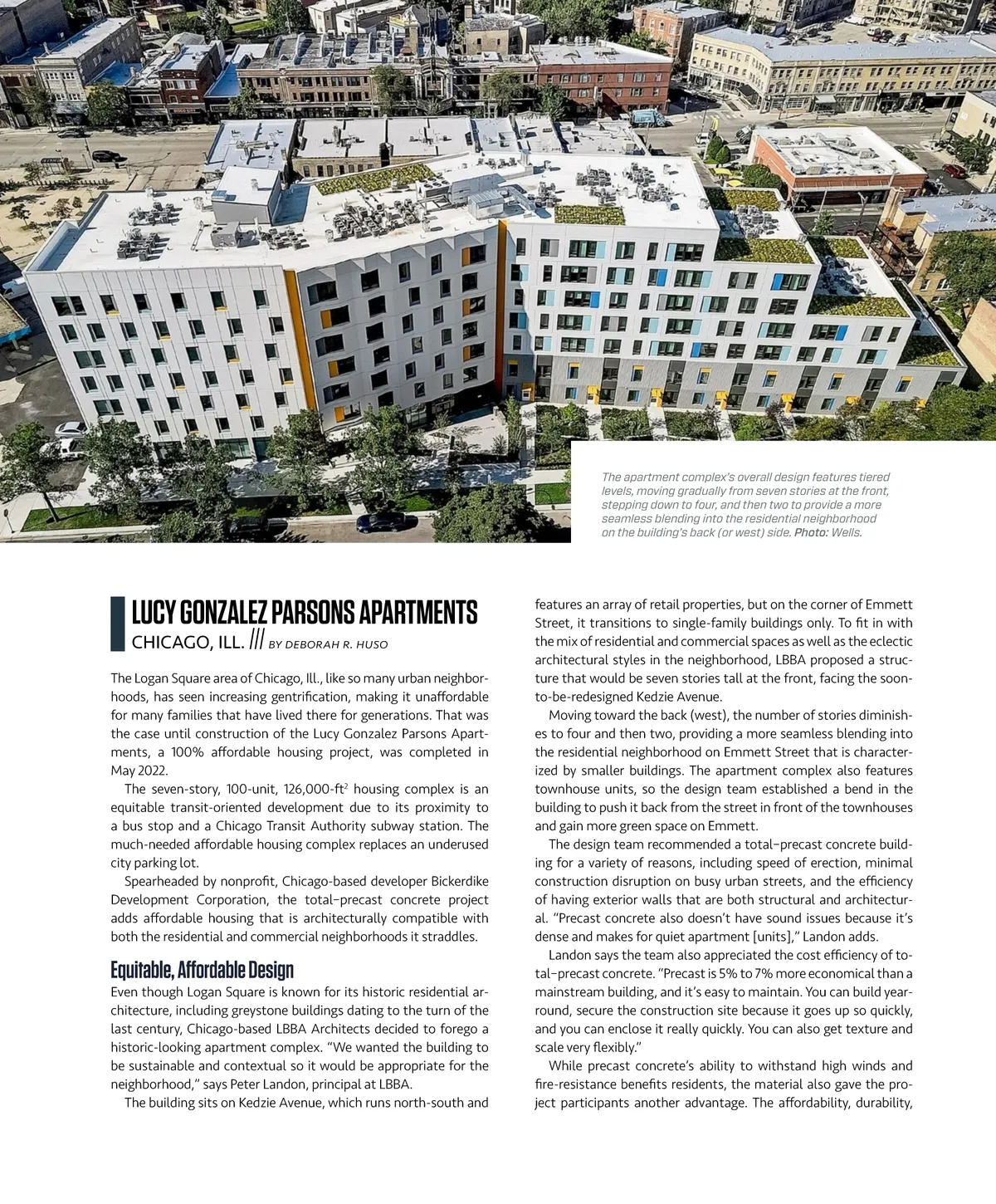
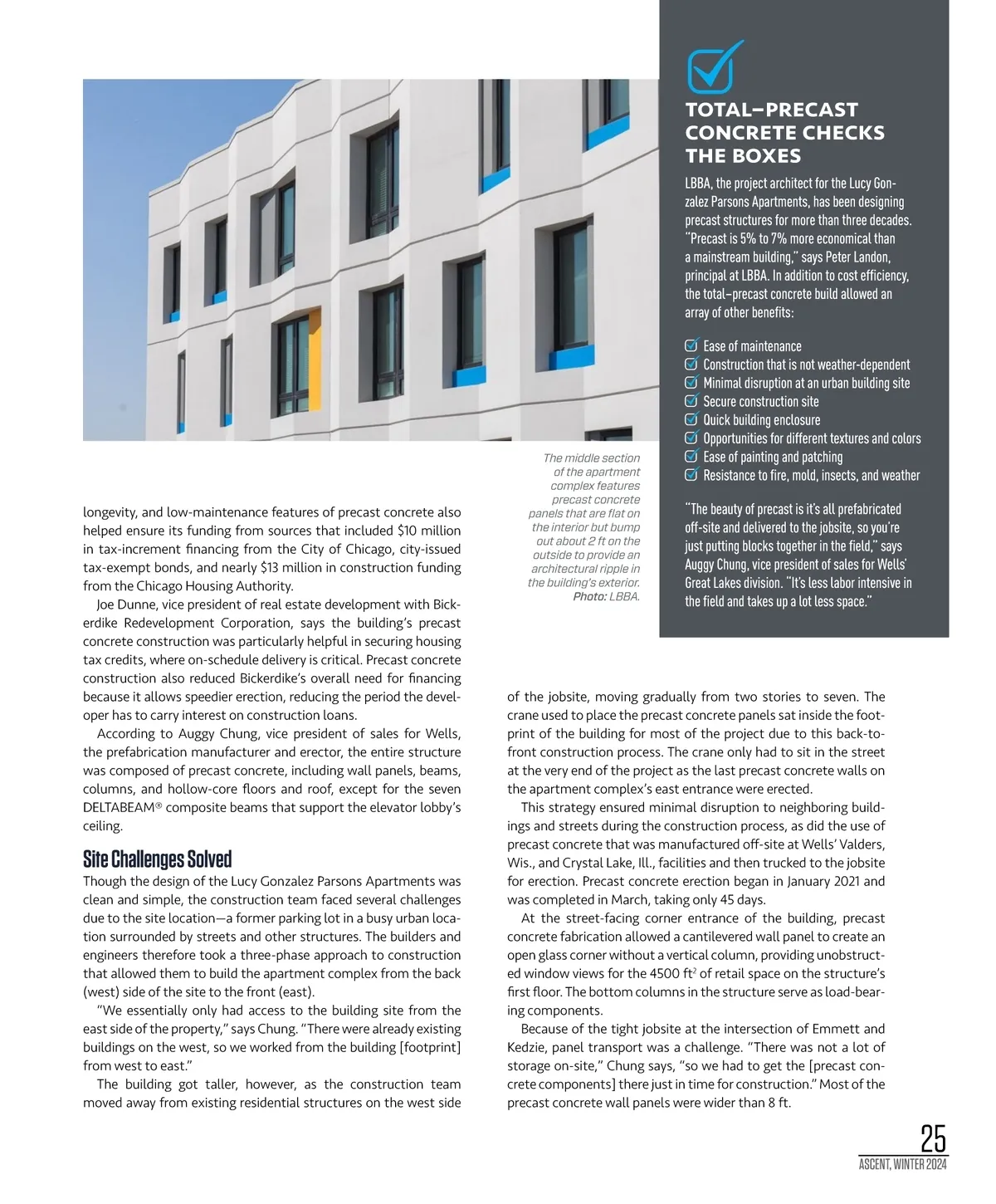
ToTal–PrecasT concreTe checks The Boxes LBBA, the project architect for the Lucy Gon-zalez Parsons Apartments, has been designing precast structures for more than three decades. “Precast is 5% to 7% more economical than a mainstream building,” says Peter Landon, principal at LBBA. In addition to cost efficiency, the total–precast concrete build allowed an array of other benefits: Ease of maintenance Construction that is not weather-dependent Minimal disruption at an urban building site Secure construction site Quick building enclosure Opportunities for different textures and colors Ease of painting and patching Resistance to fire, mold, insects, and weather “The beauty of precast is it’s all prefabricated off-site and delivered to the jobsite, so you’re just putting blocks together in the field,” says Auggy Chung, vice president of sales for Wells’ Great Lakes division. “It’s less labor intensive in the field and takes up a lot less space.” longevity, and low-maintenance features of precast concrete also helped ensure its funding from sources that included $10 million in tax-increment financing from the City of Chicago, city-issued tax-exempt bonds, and nearly $13 million in construction funding from the Chicago Housing Authority. Joe Dunne, vice president of real estate development with Bick-erdike Redevelopment Corporation, says the building’s precast concrete construction was particularly helpful in securing housing tax credits, where on-schedule delivery is critical. Precast concrete construction also reduced Bickerdike’s overall need for financing because it allows speedier erection, reducing the period the devel-oper has to carry interest on construction loans. According to Auggy Chung, vice president of sales for Wells, the prefabrication manufacturer and erector, the entire structure was composed of precast concrete, including wall panels, beams, columns, and hollow-core floors and roof, except for the seven DELTABEAM® composite beams that support the elevator lobby’s ceiling. The middle section of the apartment complex features precast concrete panels that are flat on the interior but bump out about 2 ft on the outside to provide an architectural ripple in the building’s exterior. Photo: LBBA. Site Challenges Solved Though the design of the Lucy Gonzalez Parsons Apartments was clean and simple, the construction team faced several challenges due to the site location—a former parking lot in a busy urban loca-tion surrounded by streets and other structures. The builders and engineers therefore took a three-phase approach to construction that allowed them to build the apartment complex from the back (west) side of the site to the front (east). “We essentially only had access to the building site from the east side of the property,” says Chung. “There were already existing buildings on the west, so we worked from the building [footprint] from west to east.” The building got taller, however, as the construction team moved away from existing residential structures on the west side of the jobsite, moving gradually from two stories to seven. The crane used to place the precast concrete panels sat inside the foot-print of the building for most of the project due to this back-to-front construction process. The crane only had to sit in the street at the very end of the project as the last precast concrete walls on the apartment complex’s east entrance were erected. This strategy ensured minimal disruption to neighboring build-ings and streets during the construction process, as did the use of precast concrete that was manufactured off-site at Wells’ Valders, Wis., and Crystal Lake, Ill., facilities and then trucked to the jobsite for erection. Precast concrete erection began in January 2021 and was completed in March, taking only 45 days. At the street-facing corner entrance of the building, precast concrete fabrication allowed a cantilevered wall panel to create an open glass corner without a vertical column, providing unobstruct-ed window views for the 4500 ft 2 of retail space on the structure’s first floor. The bottom columns in the structure serve as load-bear-ing components. Because of the tight jobsite at the intersection of Emmett and Kedzie, panel transport was a challenge. “There was not a lot of storage on-site,” Chung says, “so we had to get the [precast con-crete components] there just in time for construction.” Most of the precast concrete wall panels were wider than 8 ft. ASCENT, WINTER 2024 25
Ascent Winter 2024: Page 25