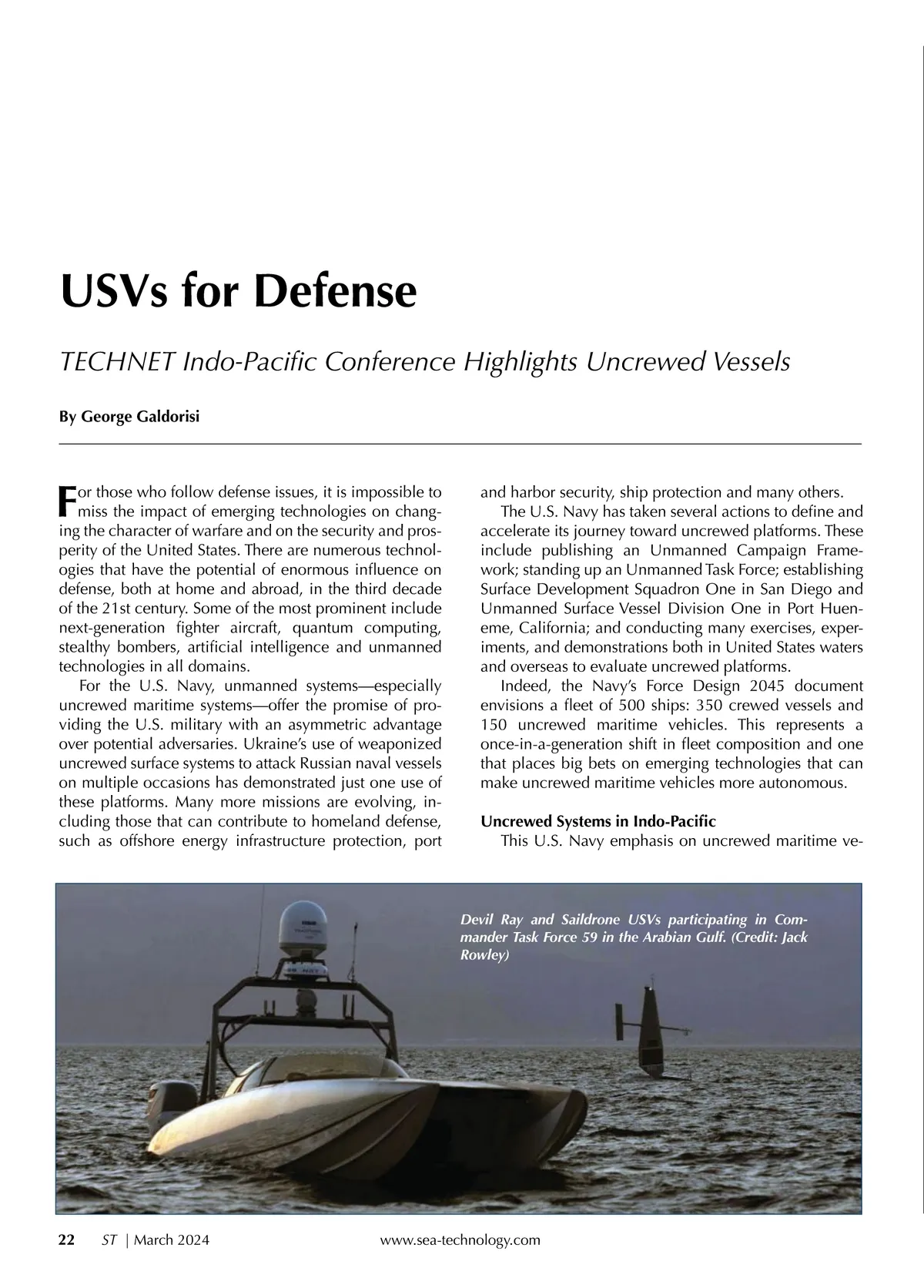
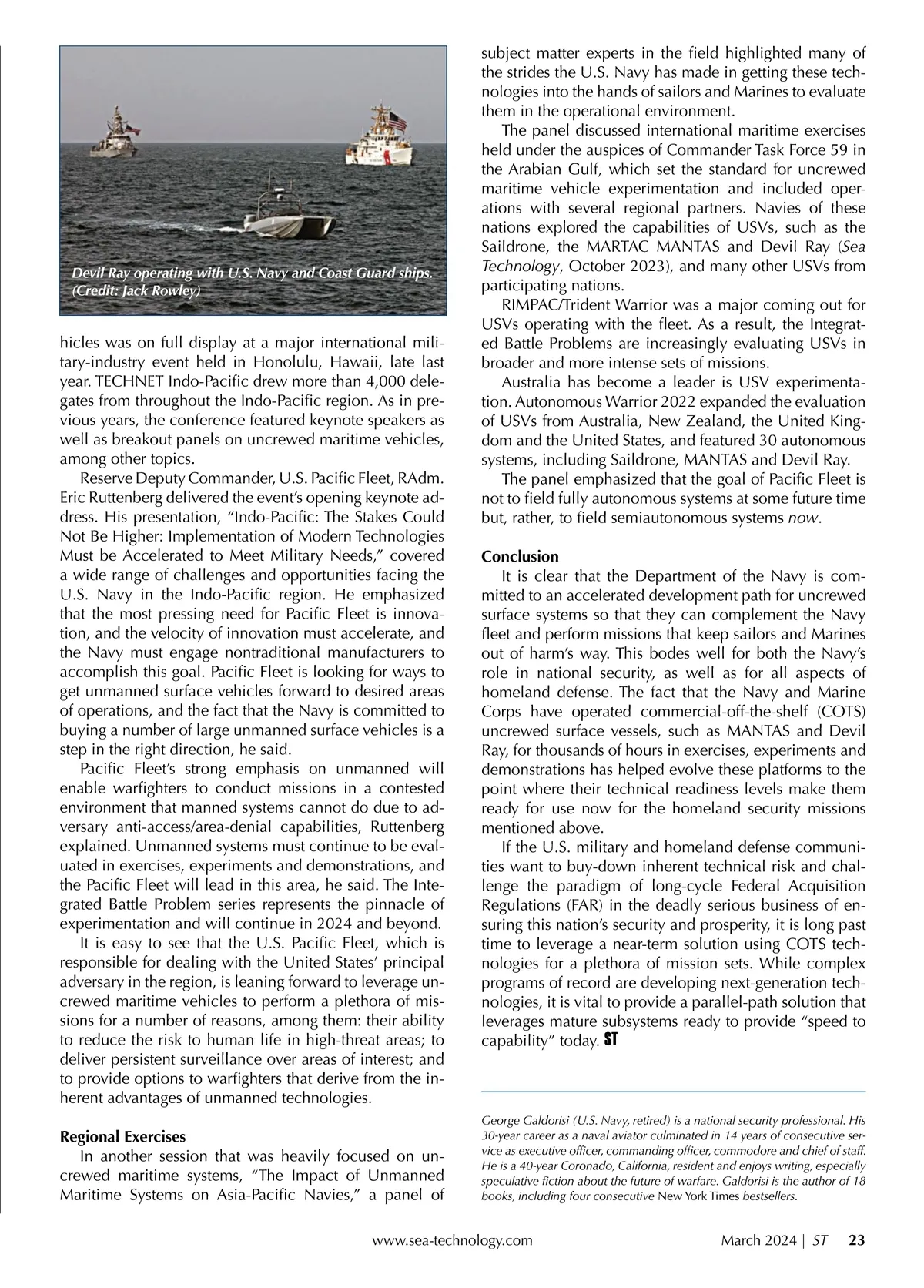
Devil Ray operating with U.S. Navy and Coast Guard ships. (Credit: Jack Rowley) hicles was on full display at a major international mili-tary-industry event held in Honolulu, Hawaii, late last year. TECHNET Indo-Pacific drew more than 4,000 dele-gates from throughout the Indo-Pacific region. As in pre-vious years, the conference featured keynote speakers as well as breakout panels on uncrewed maritime vehicles, among other topics. Reserve Deputy Commander, U.S. Pacific Fleet, RAdm. Eric Ruttenberg delivered the event’s opening keynote ad-dress. His presentation, “Indo-Pacific: The Stakes Could Not Be Higher: Implementation of Modern Technologies Must be Accelerated to Meet Military Needs,” covered a wide range of challenges and opportunities facing the U.S. Navy in the Indo-Pacific region. He emphasized that the most pressing need for Pacific Fleet is innova-tion, and the velocity of innovation must accelerate, and the Navy must engage nontraditional manufacturers to accomplish this goal. Pacific Fleet is looking for ways to get unmanned surface vehicles forward to desired areas of operations, and the fact that the Navy is committed to buying a number of large unmanned surface vehicles is a step in the right direction, he said. Pacific Fleet’s strong emphasis on unmanned will enable warfighters to conduct missions in a contested environment that manned systems cannot do due to ad-versary anti-access/area-denial capabilities, Ruttenberg explained. Unmanned systems must continue to be eval-uated in exercises, experiments and demonstrations, and the Pacific Fleet will lead in this area, he said. The Inte-grated Battle Problem series represents the pinnacle of experimentation and will continue in 2024 and beyond. It is easy to see that the U.S. Pacific Fleet, which is responsible for dealing with the United States’ principal adversary in the region, is leaning forward to leverage un-crewed maritime vehicles to perform a plethora of mis-sions for a number of reasons, among them: their ability to reduce the risk to human life in high-threat areas; to deliver persistent surveillance over areas of interest; and to provide options to warfighters that derive from the in-herent advantages of unmanned technologies. Regional Exercises In another session that was heavily focused on un-crewed maritime systems, “The Impact of Unmanned Maritime Systems on Asia-Pacific Navies,” a panel of subject matter experts in the field highlighted many of the strides the U.S. Navy has made in getting these tech-nologies into the hands of sailors and Marines to evaluate them in the operational environment. The panel discussed international maritime exercises held under the auspices of Commander Task Force 59 in the Arabian Gulf, which set the standard for uncrewed maritime vehicle experimentation and included oper-ations with several regional partners. Navies of these nations explored the capabilities of USVs, such as the Saildrone, the MARTAC MANTAS and Devil Ray ( Sea Technology , October 2023), and many other USVs from participating nations. RIMPAC/Trident Warrior was a major coming out for USVs operating with the fleet. As a result, the Integrat-ed Battle Problems are increasingly evaluating USVs in broader and more intense sets of missions. Australia has become a leader is USV experimenta-tion. Autonomous Warrior 2022 expanded the evaluation of USVs from Australia, New Zealand, the United King-dom and the United States, and featured 30 autonomous systems, including Saildrone, MANTAS and Devil Ray. The panel emphasized that the goal of Pacific Fleet is not to field fully autonomous systems at some future time but, rather, to field semiautonomous systems now . Conclusion It is clear that the Department of the Navy is com-mitted to an accelerated development path for uncrewed surface systems so that they can complement the Navy fleet and perform missions that keep sailors and Marines out of harm’s way. This bodes well for both the Navy’s role in national security, as well as for all aspects of homeland defense. The fact that the Navy and Marine Corps have operated commercial-off-the-shelf (COTS) uncrewed surface vessels, such as MANTAS and Devil Ray, for thousands of hours in exercises, experiments and demonstrations has helped evolve these platforms to the point where their technical readiness levels make them ready for use now for the homeland security missions mentioned above. If the U.S. military and homeland defense communi-ties want to buy-down inherent technical risk and chal-lenge the paradigm of long-cycle Federal Acquisition Regulations (FAR) in the deadly serious business of en-suring this nation’s security and prosperity, it is long past time to leverage a near-term solution using COTS tech-nologies for a plethora of mission sets. While complex programs of record are developing next-generation tech-nologies, it is vital to provide a parallel-path solution that leverages mature subsystems ready to provide “speed to capability” today. ST George Galdorisi (U.S. Navy, retired) is a national security professional. His 30-year career as a naval aviator culminated in 14 years of consecutive ser-vice as executive officer, commanding officer, commodore and chief of staff. He is a 40-year Coronado, California, resident and enjoys writing, especially speculative fiction about the future of warfare. Galdorisi is the author of 18 books, including four consecutive New York Times bestsellers. www.sea-technology.com March 2024 | ST 23
Sea Technology March 2024: Page 23