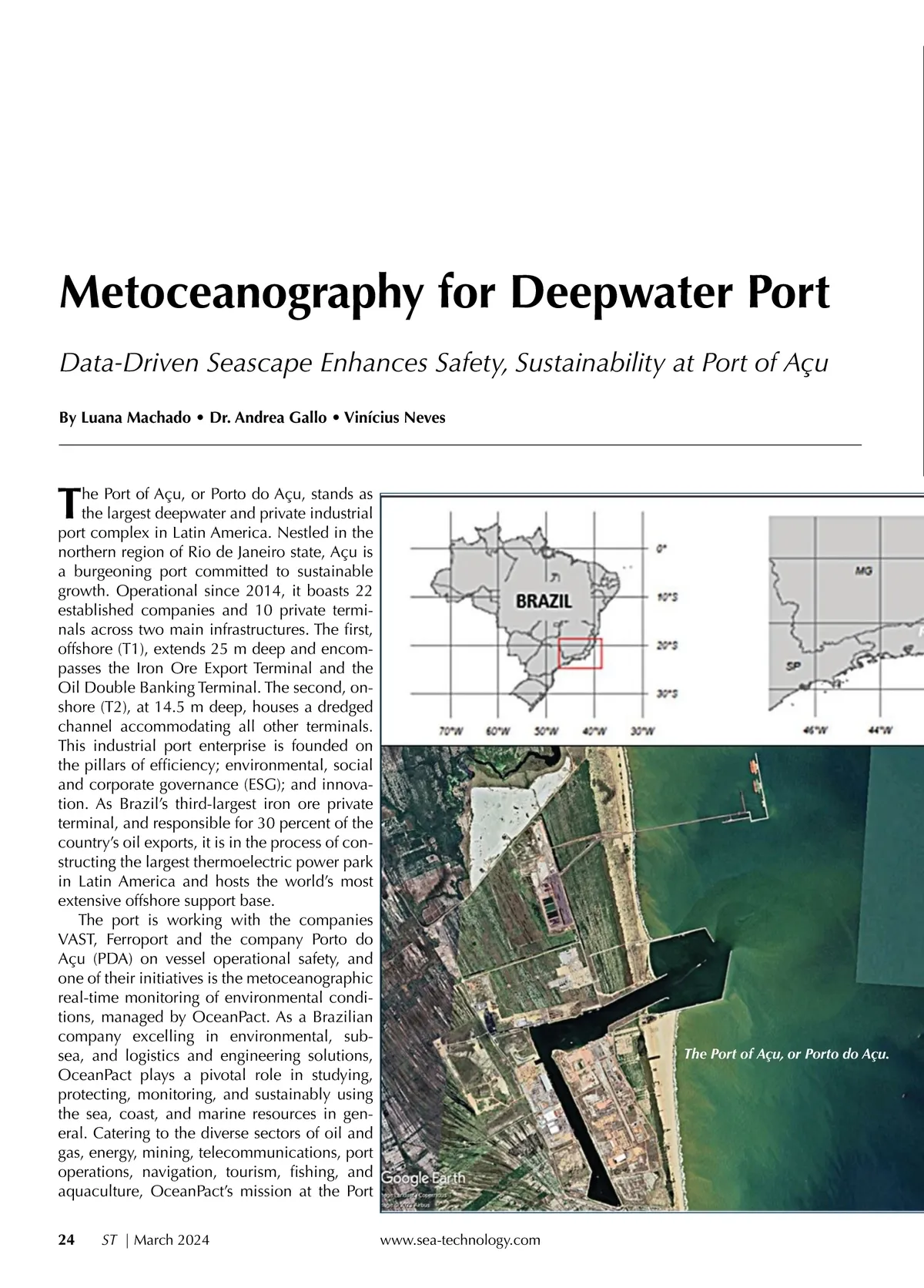
Metoceanography for Deepwater Port Data-Driven Seascape Enhances Safety, Sustainability at Port of Açu By Luana Machado • Dr. Andrea Gallo • Vinícius Neves T he Port of Açu, or Porto do Açu, stands as the largest deepwater and private industrial port complex in Latin America. Nestled in the northern region of Rio de Janeiro state, Açu is a burgeoning port committed to sustainable growth. Operational since 2014, it boasts 22 established companies and 10 private termi-nals across two main infrastructures. The first, offshore (T1), extends 25 m deep and encom-passes the Iron Ore Export Terminal and the Oil Double Banking Terminal. The second, on-shore (T2), at 14.5 m deep, houses a dredged channel accommodating all other terminals. This industrial port enterprise is founded on the pillars of efficiency; environmental, social and corporate governance (ESG); and innova-tion. As Brazil’s third-largest iron ore private terminal, and responsible for 30 percent of the country’s oil exports, it is in the process of con-structing the largest thermoelectric power park in Latin America and hosts the world’s most extensive offshore support base. The port is working with the companies VAST, Ferroport and the company Porto do Açu (PDA) on vessel operational safety, and one of their initiatives is the metoceanographic real-time monitoring of environmental condi-tions, managed by OceanPact. As a Brazilian company excelling in environmental, sub-sea, and logistics and engineering solutions, OceanPact plays a pivotal role in studying, protecting, monitoring, and sustainably using the sea, coast, and marine resources in gen-eral. Catering to the diverse sectors of oil and gas, energy, mining, telecommunications, port operations, navigation, tourism, fishing, and aquaculture, OceanPact’s mission at the Port ST | March 2024 www.sea-technology.com The Port of Açu, or Porto do Açu. 24
Sea Technology March 2024: Page 24