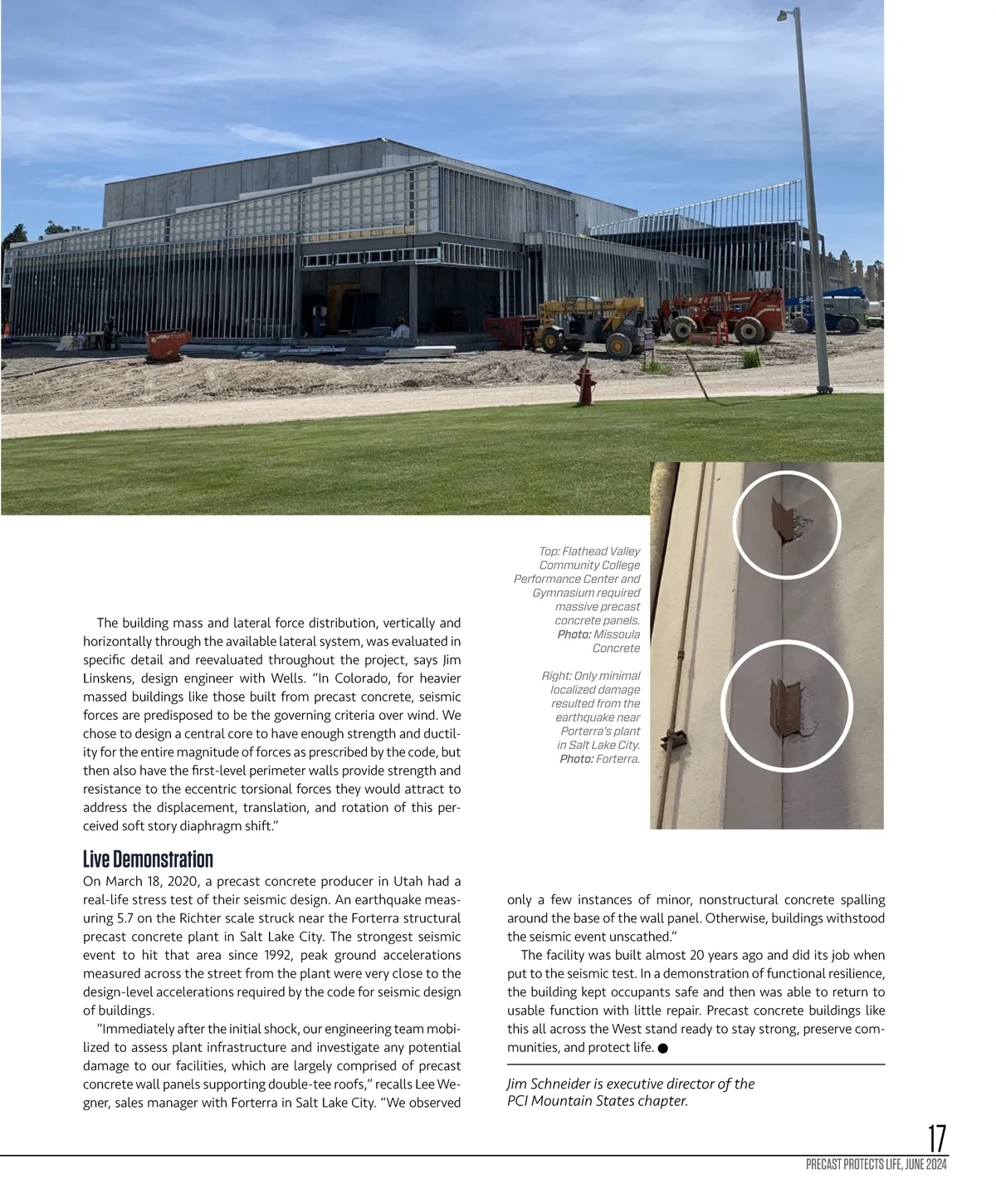
The building mass and lateral force distribution, vertically and horizontally through the available lateral system, was evaluated in specific detail and reevaluated throughout the project, says Jim Linskens, design engineer with Wells. “In Colorado, for heavier massed buildings like those built from precast concrete, seismic forces are predisposed to be the governing criteria over wind. We chose to design a central core to have enough strength and ductil-ity for the entire magnitude of forces as prescribed by the code, but then also have the first-level perimeter walls provide strength and resistance to the eccentric torsional forces they would attract to address the displacement, translation, and rotation of this per-ceived soft story diaphragm shift.” Top: Flathead Valley Community College Performance Center and Gymnasium required massive precast concrete panels. Photo: Missoula Concrete Right: Only minimal localized damage resulted from the earthquake near Porterra’s plant in Salt Lake City. Photo: Forterra. Live Demonstration On March 18, 2020, a precast concrete producer in Utah had a real-life stress test of their seismic design. An earthquake meas-uring 5.7 on the Richter scale struck near the Forterra structural precast concrete plant in Salt Lake City. The strongest seismic event to hit that area since 1992, peak ground accelerations measured across the street from the plant were very close to the design-level accelerations required by the code for seismic design of buildings. “Immediately after the initial shock, our engineering team mobi-lized to assess plant infrastructure and investigate any potential damage to our facilities, which are largely comprised of precast concrete wall panels supporting double-tee roofs,” recalls Lee We-gner, sales manager with Forterra in Salt Lake City. “We observed only a few instances of minor, nonstructural concrete spalling around the base of the wall panel. Otherwise, buildings withstood the seismic event unscathed.” The facility was built almost 20 years ago and did its job when put to the seismic test. In a demonstration of functional resilience, the building kept occupants safe and then was able to return to usable function with little repair. Precast concrete buildings like this all across the West stand ready to stay strong, preserve com-munities, and protect life. Jim Schneider is executive director of the PCI Mountain States chapter. PRECAST PROTECTS LIFE, JUNE 2024 17
Ascent Precast Protects Life June 2024: Page 17