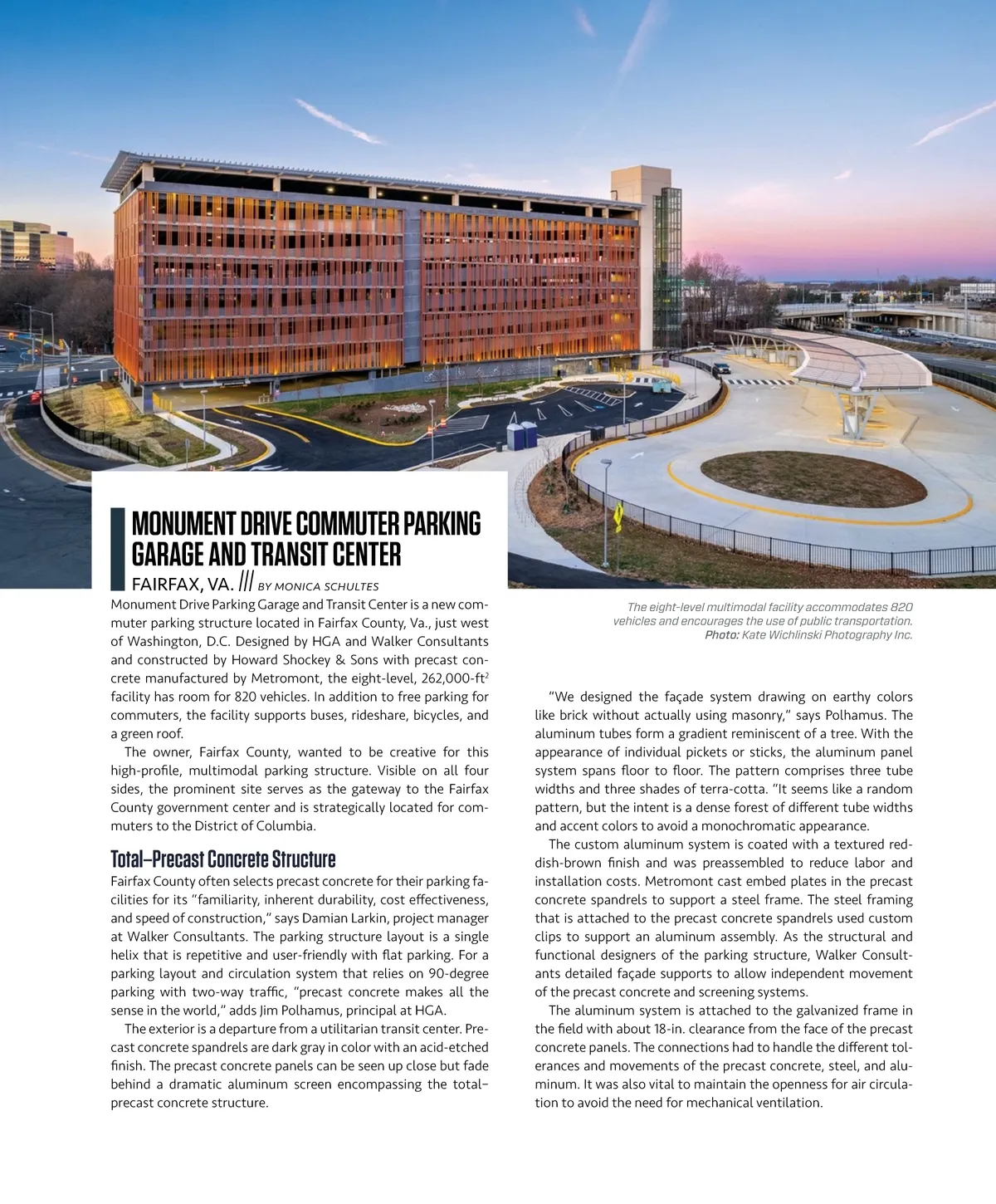
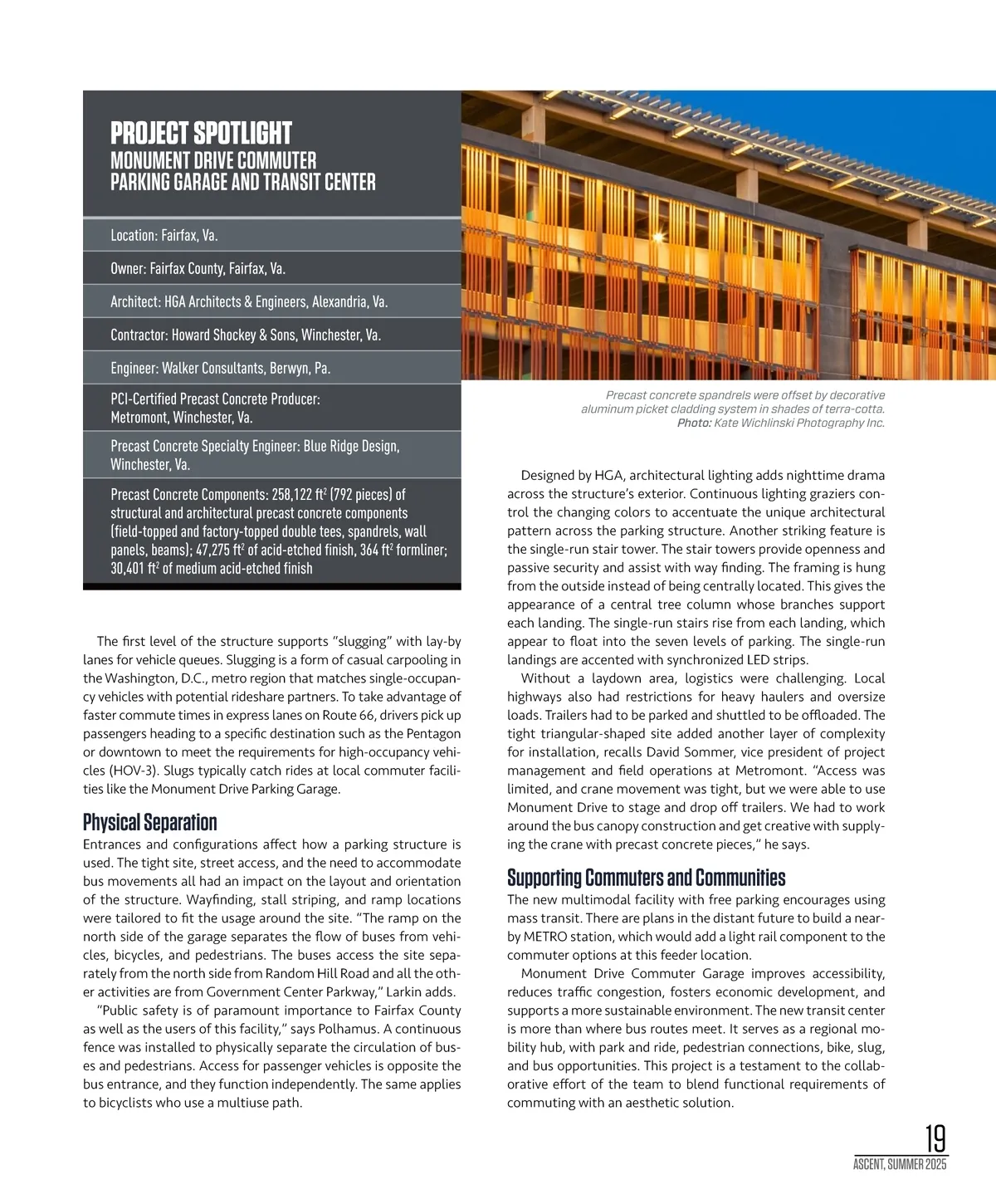
PROJECT SPOTLIGHT Location: Fairfax, Va. Owner: Fairfax County, Fairfax, Va. MONUMENT DRIVE COMMUTER PARKING GARAGE AND TRANSIT CENTER Architect: HGA Architects & Engineers, Alexandria, Va. Contractor: Howard Shockey & Sons, Winchester, Va. Engineer: Walker Consultants, Berwyn, Pa. PCI-Certified Precast Concrete Producer: Metromont, Winchester, Va. Precast Concrete Specialty Engineer: Blue Ridge Design, Winchester, Va. Precast Concrete Components: 258,122 ft 2 (792 pieces) of structural and architectural precast concrete components (field-topped and factory-topped double tees, spandrels, wall panels, beams); 47,275 ft 2 of acid-etched finish, 364 ft 2 formliner; 30,401 ft 2 of medium acid-etched finish Precast concrete spandrels were offset by decorative aluminum picket cladding system in shades of terra-cotta. Photo: Kate Wichlinski Photography Inc. The first level of the structure supports “slugging” with lay-by lanes for vehicle queues. Slugging is a form of casual carpooling in the Washington, D.C., metro region that matches single-occupan-cy vehicles with potential rideshare partners. To take advantage of faster commute times in express lanes on Route 66, drivers pick up passengers heading to a specific destination such as the Pentagon or downtown to meet the requirements for high-occupancy vehi-cles (HOV-3). Slugs typically catch rides at local commuter facili-ties like the Monument Drive Parking Garage. Physical Separation Entrances and configurations affect how a parking structure is used. The tight site, street access, and the need to accommodate bus movements all had an impact on the layout and orientation of the structure. Wayfinding, stall striping, and ramp locations were tailored to fit the usage around the site. “The ramp on the north side of the garage separates the flow of buses from vehi-cles, bicycles, and pedestrians. The buses access the site sepa-rately from the north side from Random Hill Road and all the oth-er activities are from Government Center Parkway,” Larkin adds. “Public safety is of paramount importance to Fairfax County as well as the users of this facility,” says Polhamus. A continuous fence was installed to physically separate the circulation of bus-es and pedestrians. Access for passenger vehicles is opposite the bus entrance, and they function independently. The same applies to bicyclists who use a multiuse path. Designed by HGA, architectural lighting adds nighttime drama across the structure’s exterior. Continuous lighting graziers con-trol the changing colors to accentuate the unique architectural pattern across the parking structure. Another striking feature is the single-run stair tower. The stair towers provide openness and passive security and assist with way finding. The framing is hung from the outside instead of being centrally located. This gives the appearance of a central tree column whose branches support each landing. The single-run stairs rise from each landing, which appear to float into the seven levels of parking. The single-run landings are accented with synchronized LED strips. Without a laydown area, logistics were challenging. Local highways also had restrictions for heavy haulers and oversize loads. Trailers had to be parked and shuttled to be offloaded. The tight triangular-shaped site added another layer of complexity for installation, recalls David Sommer, vice president of project management and field operations at Metromont. “Access was limited, and crane movement was tight, but we were able to use Monument Drive to stage and drop off trailers. We had to work around the bus canopy construction and get creative with supply-ing the crane with precast concrete pieces,” he says. Supporting Commuters and Communities The new multimodal facility with free parking encourages using mass transit. There are plans in the distant future to build a near-by METRO station, which would add a light rail component to the commuter options at this feeder location. Monument Drive Commuter Garage improves accessibility, reduces traffic congestion, fosters economic development, and supports a more sustainable environment. The new transit center is more than where bus routes meet. It serves as a regional mo-bility hub, with park and ride, pedestrian connections, bike, slug, and bus opportunities. This project is a testament to the collab-orative effort of the team to blend functional requirements of commuting with an aesthetic solution. ASCENT, SUMMER 2025 19
Ascent Summer 2025: Page 19