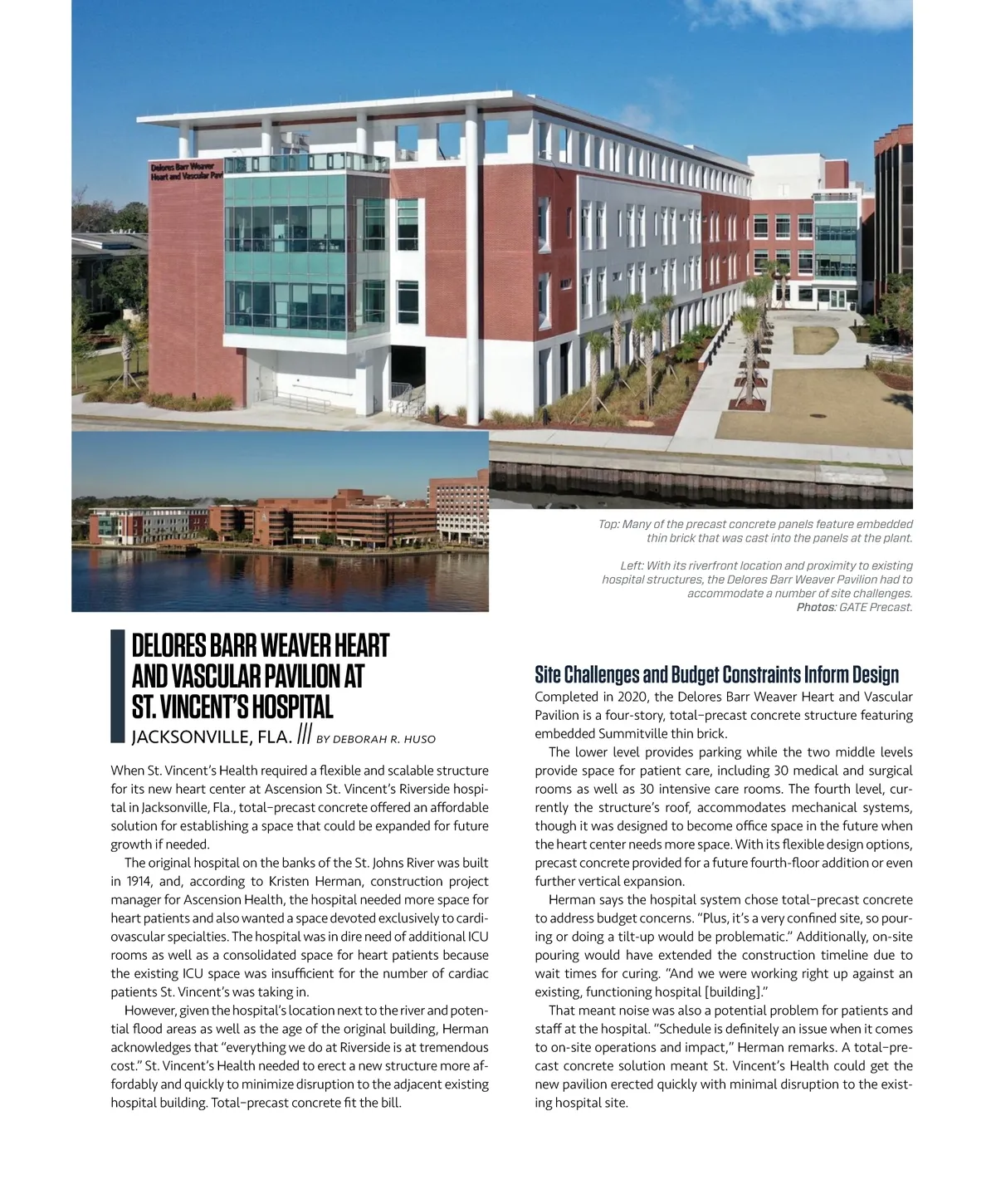
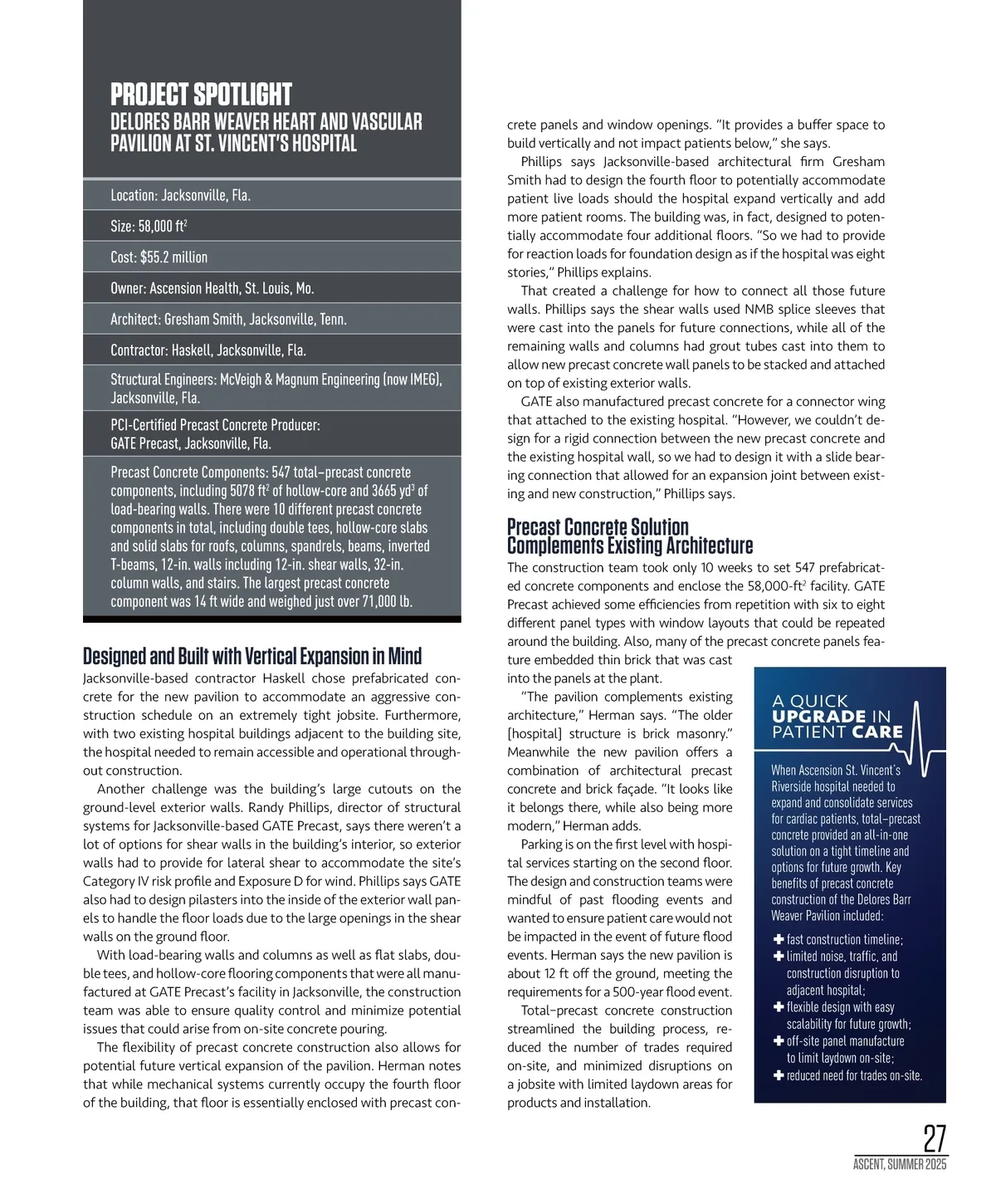
PROJECT SPOTLIGHT Location: Jacksonville, Fla. Size: 58,000 ft 2 Cost: $55.2 million DELORES BARR WEAVER HEART AND VASCULAR PAVILION AT ST. VINCENT'S HOSPITAL Owner: Ascension Health, St. Louis, Mo. Architect: Gresham Smith, Jacksonville, Tenn. Contractor: Haskell, Jacksonville, Fla. Structural Engineers: McVeigh & Magnum Engineering (now IMEG), Jacksonville, Fla. PCI-Certified Precast Concrete Producer: GATE Precast, Jacksonville, Fla. Precast Concrete Components: 547 total–precast concrete components, including 5078 ft 2 of hollow-core and 3665 yd 3 of load-bearing walls. There were 10 different precast concrete components in total, including double tees, hollow-core slabs and solid slabs for roofs, columns, spandrels, beams, inverted T-beams, 12-in. walls including 12-in. shear walls, 32-in. column walls, and stairs. The largest precast concrete component was 14 ft wide and weighed just over 71,000 lb. crete panels and window openings. “It provides a buffer space to build vertically and not impact patients below,” she says. Phillips says Jacksonville-based architectural firm Gresham Smith had to design the fourth floor to potentially accommodate patient live loads should the hospital expand vertically and add more patient rooms. The building was, in fact, designed to poten-tially accommodate four additional floors. “So we had to provide for reaction loads for foundation design as if the hospital was eight stories,” Phillips explains. That created a challenge for how to connect all those future walls. Phillips says the shear walls used NMB splice sleeves that were cast into the panels for future connections, while all of the remaining walls and columns had grout tubes cast into them to allow new precast concrete wall panels to be stacked and attached on top of existing exterior walls. GATE also manufactured precast concrete for a connector wing that attached to the existing hospital. “However, we couldn’t de-sign for a rigid connection between the new precast concrete and the existing hospital wall, so we had to design it with a slide bear-ing connection that allowed for an expansion joint between exist-ing and new construction,” Phillips says. Precast Concrete Solution Complements Existing Architecture The construction team took only 10 weeks to set 547 prefabricat-ed concrete components and enclose the 58,000-ft 2 facility. GATE Precast achieved some efficiencies from repetition with six to eight different panel types with window layouts that could be repeated around the building. Also, many of the precast concrete panels fea-ture embedded thin brick that was cast into the panels at the plant. “The pavilion complements existing architecture,” Herman says. “The older [hospital] structure is brick masonry.” Meanwhile the new pavilion offers a combination of architectural precast When Ascension St. Vincent’s Riverside hospital needed to concrete and brick façade. “It looks like expand and consolidate services it belongs there, while also being more for cardiac patients, total–precast modern,” Herman adds. concrete provided an all-in-one Parking is on the first level with hospi-solution on a tight timeline and tal services starting on the second floor. options for future growth. Key The design and construction teams were benefits of precast concrete mindful of past flooding events and construction of the Delores Barr Weaver Pavilion included: wanted to ensure patient care would not be impacted in the event of future flood ≠ fast construction timeline; events. Herman says the new pavilion is ≠ limited noise, traffic, and about 12 ft off the ground, meeting the construction disruption to adjacent hospital; requirements for a 500-year flood event. ≠ flexible design with easy Total–precast concrete construction scalability for future growth; streamlined the building process, re-≠ off-site panel manufacture duced the number of trades required to limit laydown on-site; on-site, and minimized disruptions on ≠ reduced need for trades on-site. a jobsite with limited laydown areas for products and installation. Designed and Built with Vertical Expansion in Mind Jacksonville-based contractor Haskell chose prefabricated con-crete for the new pavilion to accommodate an aggressive con-struction schedule on an extremely tight jobsite. Furthermore, with two existing hospital buildings adjacent to the building site, the hospital needed to remain accessible and operational through-out construction. Another challenge was the building’s large cutouts on the ground-level exterior walls. Randy Phillips, director of structural systems for Jacksonville-based GATE Precast, says there weren’t a lot of options for shear walls in the building’s interior, so exterior walls had to provide for lateral shear to accommodate the site’s Category IV risk profile and Exposure D for wind. Phillips says GATE also had to design pilasters into the inside of the exterior wall pan-els to handle the floor loads due to the large openings in the shear walls on the ground floor. With load-bearing walls and columns as well as flat slabs, dou-ble tees, and hollow-core flooring components that were all manu-factured at GATE Precast’s facility in Jacksonville, the construction team was able to ensure quality control and minimize potential issues that could arise from on-site concrete pouring. The flexibility of precast concrete construction also allows for potential future vertical expansion of the pavilion. Herman notes that while mechanical systems currently occupy the fourth floor of the building, that floor is essentially enclosed with precast con-A Quick Upgrade in PAtient Care ASCENT, SUMMER 2025 27
Ascent Summer 2025: Page 27