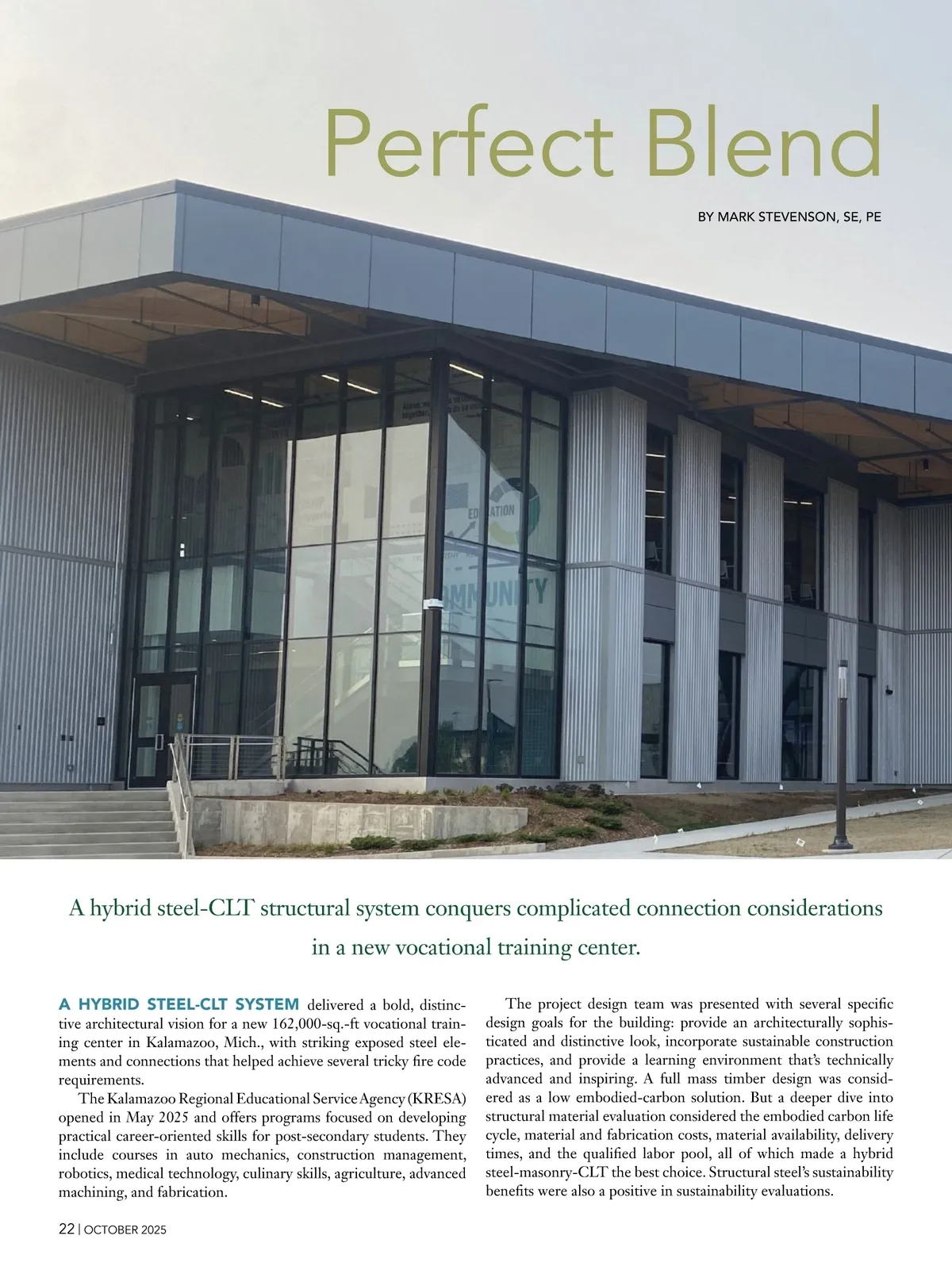
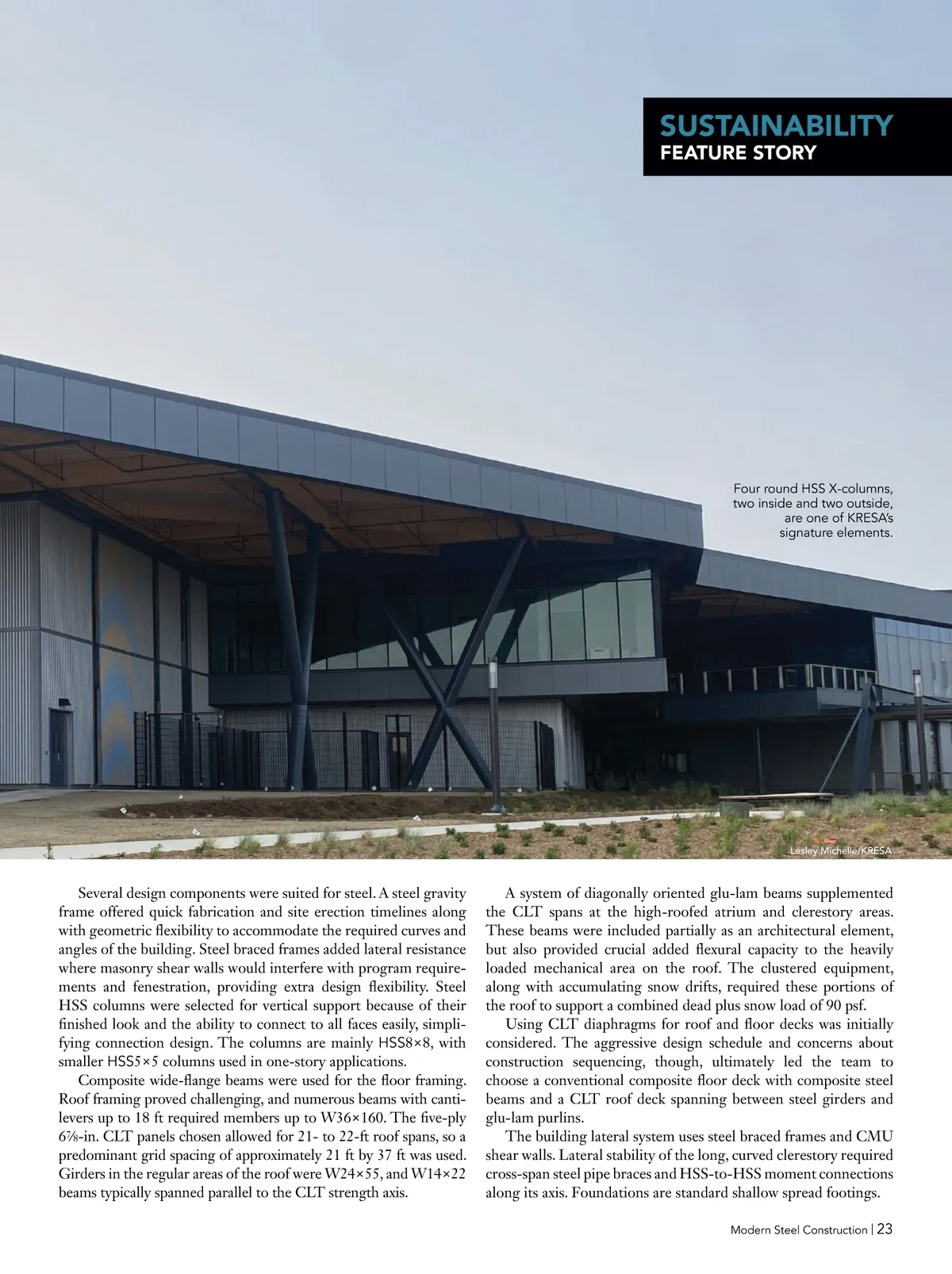
SUSTAINABILITY FEATURE STORY Four round HSS X-columns, two inside and two outside, are one of KRESA’s signature elements. Lesley Michelle/KRESA Several design components were suited for steel. A steel gravity frame offered quick fabrication and site erection timelines along with geometric flexibility to accommodate the required curves and angles of the building. Steel braced frames added lateral resistance where masonry shear walls would interfere with program require-ments and fenestration, providing extra design flexibility. Steel HSS columns were selected for vertical support because of their finished look and the ability to connect to all faces easily, simpli-fying connection design. The columns are mainly HSS 8 × 8, with smaller HSS 5 × 5 columns used in one-story applications. Composite wide-flange beams were used for the floor framing. Roof framing proved challenging, and numerous beams with canti-levers up to 18 ft required members up to W36 × 160. The five-ply 6 7 ⁄ 8 -in. CLT panels chosen allowed for 21-to 22-ft roof spans, so a predominant grid spacing of approximately 21 ft by 37 ft was used. Girders in the regular areas of the roof were W24 × 55, and W14 × 22 beams typically spanned parallel to the CLT strength axis. A system of diagonally oriented glu-lam beams supplemented the CLT spans at the high-roofed atrium and clerestory areas. These beams were included partially as an architectural element, but also provided crucial added flexural capacity to the heavily loaded mechanical area on the roof. The clustered equipment, along with accumulating snow drifts, required these portions of the roof to support a combined dead plus snow load of 90 psf. Using CLT diaphragms for roof and floor decks was initially considered. The aggressive design schedule and concerns about construction sequencing, though, ultimately led the team to choose a conventional composite floor deck with composite steel beams and a CLT roof deck spanning between steel girders and glu-lam purlins. The building lateral system uses steel braced frames and CMU shear walls. Lateral stability of the long, curved clerestory required cross-span steel pipe braces and HSS-to-HSS moment connections along its axis. Foundations are standard shallow spread footings. Modern Steel Construction | 23
Modern Steel Construction October 2025: Page-23